
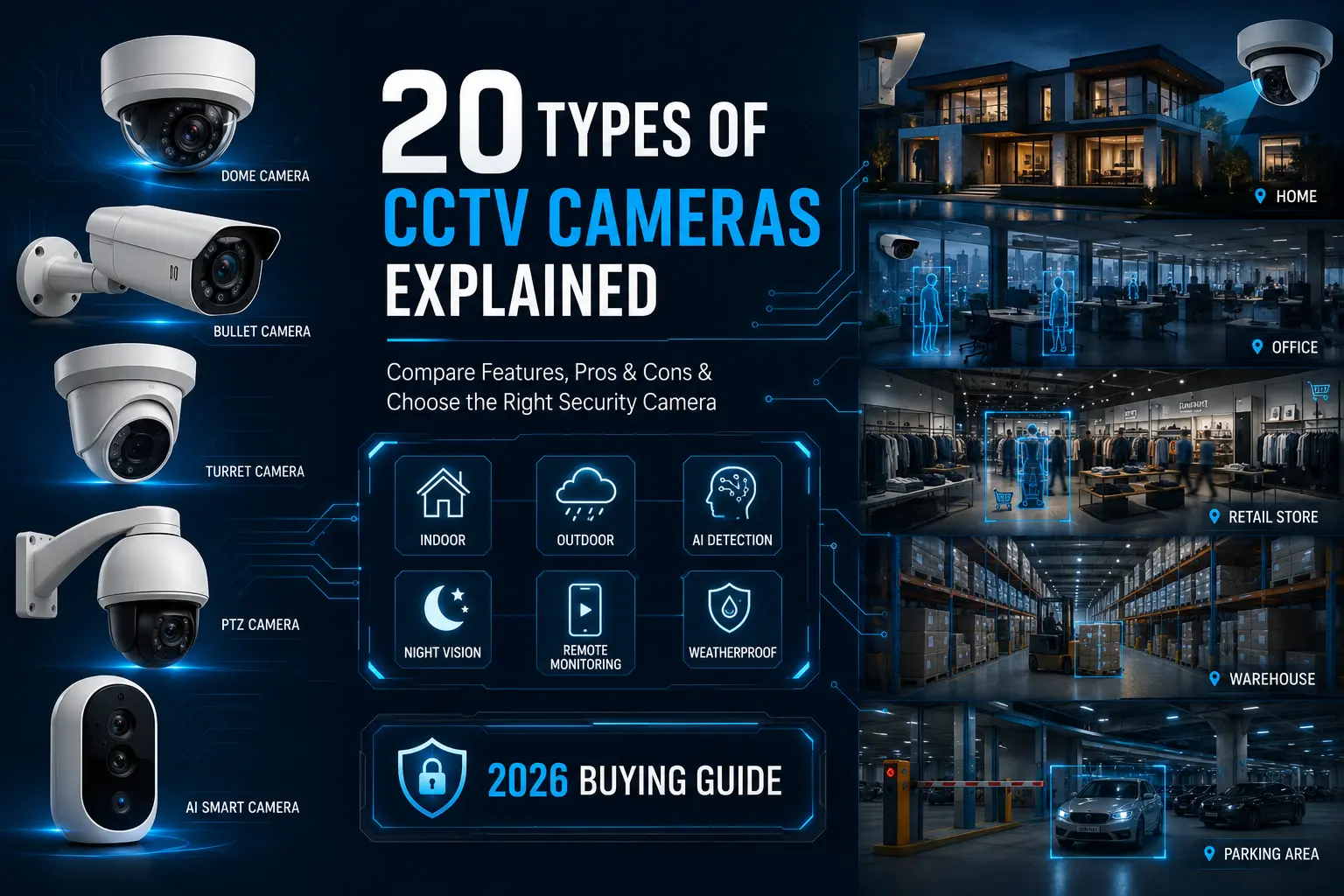
Types of CCTV Cameras Explained: How to Choose the Right Security Camera for Your Home or Business
Choosing the right security system starts with understanding the different types of CCTV cameras available on the market today. Knowing exactly which camera fits your property’s layout and security goals is the single most important step in protecting your home or business.
The sheer variety of CCTV camera types can easily confuse first-time buyers. You might walk into a tech store or browse online and wonder whether you need a dome for your ceiling or a bullet for your driveway. The confusion usually stems from the massive difference between indoor and outdoor surveillance environments, as well as the unique demands of residential versus commercial requirements.
There is no single “best” camera for every application. Camera selection should always be based on your property layout, lighting conditions, specific surveillance goals, and the installation environment, rather than just choosing the highest megapixels or the lowest price. Whether you need discreet indoor monitoring or heavy-duty perimeter defense, understanding the different types of CCTV cameras ensures you invest in reliable protection without overspending.
What Are the Different Types of CCTV Cameras?
When you ask what are the different types of CCTV cameras, the answer breaks down into three major categories: fixed cameras, smart network cameras, and specialty cameras. Fixed cameras, like domes and bullets, look at one specific area permanently. Smart network cameras handle how the video data is processed and transmitted over the internet. Specialty cameras feature advanced sensors to track moving targets, see through total darkness, or read license plates.
Each camera utilizes a specialized internal CMOS image sensor to convert light into a digital signal, but they serve distinctly different surveillance purposes based on their exterior housing.
The most common types of CCTV cameras include Dome, Bullet, Turret, PTZ, IP, Analog, Wireless, PoE, Fisheye, Panoramic, Box, C-Mount, Day/Night, Infrared, Thermal, ANPR, AI, Hidden, Mini, and Solar-powered cameras.
Fixed CCTV Camera Types for Everyday Surveillance
Fixed cameras are the backbone of modern security. Once mounted and aimed, they provide a constant, unchanging view of a specific zone.
Dome CCTV Camera
A dome camera gets its name from its circular, dome-shaped housing. Designed primarily for indoor use, the tinted glass makes it incredibly difficult for intruders to see exactly where the lens is pointing. They feature excellent vandal resistance because the housing protects the delicate lens inside. While their compact design looks great on ceilings, the glass can sometimes cause infrared glare at night. They are best for homes, offices, and apartments.
Bullet CCTV Camera
Bullet cameras are highly visible, cylindrical cameras designed to act as a strong deterrent against crime. Built for outdoor surveillance, they feature rugged, weatherproof designs (typically carrying an IP66 or IP67 rating to block dust and heavy rain) and extended long-distance viewing capabilities. While they are easy to aim, they are also easier for vandals to physically reposition than dome cameras. They are best for parking areas, long driveways, and main entrances.
Turret CCTV Camera
Turret cameras feature a ball-and-socket joint design. Unlike domes, the lens sits outside of a glass housing, resulting in a completely anti-glare design. This gives turrets significantly better night vision since infrared light won’t bounce back into the lens. They offer highly flexible installation on both walls and ceilings. Their superior image clarity makes them a top choice for modern setups.
Box CCTV Camera
Box cameras are traditional, heavy-duty cameras built for industrial monitoring. Their main advantage is the ability to use interchangeable lenses, allowing security teams to swap out the glass to perfectly match a specific viewing angle. They are ideal for long-distance monitoring across expansive factory floors.
C-Mount CCTV Camera
Similar to box cameras, C-Mount cameras use adjustable lenses for highly specialized surveillance. Standard CCTV lenses can only view distances of roughly 35 to 40 feet, but a C-Mount camera allows you to attach special lenses that cover much longer distances. They are heavily utilized in industrial applications and large logistical hubs.
Smart and Network CCTV Camera Types
This category defines how cameras process video and communicate with your recording system.
IP CCTV Camera
An IP (Internet Protocol) camera digitizes the video signal internally and sends it over your computer network. Network-based surveillance provides stunningly high-resolution recording and seamless remote monitoring. Modern IP cameras use ONVIF (Open Network Video Interface Forum) compliance, ensuring they can seamlessly communicate with recording devices from different manufacturers. For a deeper technical dive, read our comprehensive analog vs IP cameras comparison.
Analog CCTV Camera
Analog cameras represent traditional, cost-effective security systems. They send raw, uncompressed video signals through heavy coaxial cables directly to a DVR. While they lack the ultra-high resolution and smart features of IP cameras, their proven reliability makes them an excellent choice for basic DVR compatibility and budget-conscious upgrades.
Wireless CCTV Camera
Wireless cameras use your property’s Wi-Fi connectivity to transmit video data, eliminating the need to run long data cables through your walls. They offer incredibly easy installation, making them highly popular for quick home security setups. However, they still require a constant electrical power cable unless they run on batteries.
PoE CCTV Camera
PoE (Power over Ethernet) allows a single network cable to deliver both the data connection and electrical power to the camera. This guarantees highly reliable power without relying on unstable Wi-Fi signals. PoE systems are the absolute gold standard for permanent business deployments and large residential networks.
AI Smart CCTV Camera
AI cameras are a massive leap forward in surveillance. They use deep-learning software to understand exactly what they are looking at, dramatically cutting down on useless recordings. Top AI features include:
- Human Detection: Filters out moving trees or shadows, sending alerts only when a person enters the frame.
- Vehicle Detection: Identifies cars and trucks approaching your property.
- Face Recognition: Logs faces and can alert you if a known VIP or banned individual arrives.
- Intrusion Detection: Triggers an alarm when an object enters a custom-drawn digital zone.
- Line Crossing Alerts: Notifies you immediately if someone crosses a digital perimeter fence.
- Smart Search: Allows you to quickly filter hours of playback footage to find only the clips containing humans or vehicles.
- False Alarm Reduction: Saves massive amounts of storage by ignoring stray animals and changing weather conditions.
Specialty CCTV Cameras for Advanced Security Applications
When standard fixed cameras aren’t enough, specialty cameras solve unique security challenges.
PTZ Camera
PTZ stands for Pan, Tilt, and Zoom. These motorized cameras can sweep left and right, tilt up and down, and use optical zoom (which physically moves the lens to maintain sharp quality, unlike digital zoom which simply enlarges pixels). Security guards use them for active monitoring to track suspicious activity across massive parking lots.
Fisheye Camera
Fisheye cameras use an ultra-wide lens to provide complete 360° surveillance from a single central point. Instead of installing four cameras in the corners of a room, one fisheye covers the entire Field of View (FOV). They are highly efficient for retail shops and warehouses.
Panoramic Camera
Panoramic cameras stitch together images from multiple lenses to create one massive, wide field of view. This multi-sensor technology delivers extreme high-resolution images across a 180° or 360° span without the edge distortion commonly found in fisheye lenses.
Day/Night CCTV Camera
These cameras feature automatic light adjustment capabilities. They rely on an excellent Lux rating (a measurement of how well a camera sees in low light) to operate effectively in bright sunlight and switch filters to see clearly in near-total darkness.
Infrared (IR) Night Vision Camera
Standard night vision relies on IR LEDs surrounding the lens. These LEDs blast invisible infrared light into the dark, allowing the camera’s sensor to capture crisp black-and-white video in zero-lux conditions. Exceptional low-light performance makes them mandatory for outdoor security.
Thermal CCTV Camera
Thermal cameras do not see light; they detect heat. They can spot a human body or a vehicle engine through heavy fog, thick smoke, or total pitch blackness. Their unmatched heat detection makes them essential for industrial security and critical perimeter protection.
ANPR / LPR Camera
Automatic Number Plate Recognition (ANPR) cameras use specialized shutter speeds to capture fast-moving vehicle plates regardless of headlight glare. They are heavily deployed at toll booths, commercial parking gates, and upscale gated communities.
Hidden / Covert Camera
Covert cameras are built to look like everyday objects like smoke detectors or clocks for discreet monitoring. Buyers must strictly adhere to local legal considerations regarding privacy and consent before installing them.
Mini CCTV Camera
Mini cameras offer extremely compact surveillance. They are small enough to sit quietly on a bookshelf or blend into retail shelving, providing excellent indoor monitoring without making guests or customers uncomfortable.
Solar CCTV Camera
For remote locations completely disconnected from the electrical grid, solar cameras are the perfect solution. They combine low-power sensors, an internal battery, and an attached solar panel to provide endless, off-grid surveillance for farms or construction sites.
How to Choose the Right CCTV Camera
Many users don’t know how to decide between these options. Before buying, narrow down your choices by evaluating these core factors:
- Installation Location: Is the camera mounting to a low ceiling (use a dome) or a high exterior pole (use a bullet or PTZ)?
- Indoor vs Outdoor: Outdoor cameras require heavy weatherproofing, while indoor cameras prioritize a discreet design.
- Lighting Conditions: If the camera faces a bright glass door, you must buy one equipped with Wide Dynamic Range (WDR) to prevent the incoming person from looking like a dark shadow.
- Monitoring Distance: Use standard lenses for viewing areas under 30 feet, and optical zoom or C-Mount cameras for distant perimeter gates.
- Viewing Angle (FOV): A narrow FOV captures fine details (like faces at a register), while a wide FOV monitors broad areas (like a warehouse floor).
- Budget: Analog is budget-friendly; AI-powered IP cameras cost more upfront but save money on future storage and false alarms.
- Internet Availability: If you lack Wi-Fi, you will need a hardwired PoE system or a 4G/LTE cellular camera.
- Recording Needs: Continuous recording demands a massive hard drive, while motion-only recording requires less space. If storage is tight, ensure your cameras support H.265 video compression to shrink file sizes by up to 50%.
Ultimate Camera Placement Guide
Visualizing your layout helps dictate which camera types you actually need. Here is a typical camera distribution for a residential property:
🏠 Residential Camera Placement Guide
- [Driveway] ➔ Bullet Camera (Provides long-distance viewing and acts as a highly visible theft deterrent).
- [Front Door] ➔ Turret Camera (Delivers glare-free night vision for clear facial identification of visitors).
- [Living Room] ➔ Dome Camera (Offers a wide field of view while remaining visually discreet on the ceiling).
- [Backyard] ➔ Bullet Camera (Ensures an IP67 weatherproof rating against heavy monsoon rain).
- [Garage] ➔ PoE Camera (Guarantees a stable data connection through thick concrete walls).
Dome vs Bullet vs Turret vs PTZ Camera: Which One Is Better?
If you are torn between the four most popular camera styles, use this comparison table to match the hardware to your exact needs.
| Feature | Dome | Bullet | Turret | PTZ |
|---|---|---|---|---|
| Best Use | Indoor aesthetics | Outdoor deterrence | Glare-free monitoring | Active tracking |
| Viewing Angle | Wide | Narrow / Long | Wide | Adjustable |
| Night Vision | Good (Glass glare risk) | Excellent | Superior (No glass) | Excellent |
| Installation | Ceilings | Walls | Walls / Ceilings | High poles / Corners |
| Indoor | Highly Recommended | Too bulky | Recommended | Only for massive spaces |
| Outdoor | Under eaves | Highly Recommended | Highly Recommended | Highly Recommended |
| Cost | Low | Low | Medium | High |
Which CCTV Camera Is Best for Your Property?
You rarely need just one type of camera. The most secure properties use a combination of lenses to cover different zones effectively.
Homes
Pair discreet Dome cameras in living rooms with weatherproof Turret cameras covering the driveways and back doors. This provides excellent aesthetics inside and glare-free night vision outside.
Apartments
Apartments usually only require a single, high-quality Wi-Fi or PoE Dome camera pointed at the main entryway to prevent tampering while keeping the hallway looking clean.
Shops
Retail environments benefit heavily from a Fisheye camera in the center of the ceiling to monitor the whole floor, paired with Turret cameras directly above the cash registers to capture high-resolution transaction details.
Offices
Offices should utilize standard Dome cameras in lobbies. If the office has a private server room, a smart IP camera with AI human detection is vital for restricting access.
Warehouses
Large logistics hubs require Bullet cameras covering the loading docks for long-distance viewing, and motorized PTZ cameras on the ceiling so security staff can actively zoom in on distant forklift operations.
Schools & Hospitals
Vandal-proof Dome cameras in the corridors prevent tampering, while ANPR cameras at the parking gates seamlessly track every vehicle entering the premises.
Common Mistakes When Choosing CCTV Cameras
Even the best hardware fails if poorly planned. During our residential CCTV installations in Bangalore, led by our engineering expert Siddu Swami Hiremath, a common issue we see is homeowners mounting bullet cameras too high. They place them at 15 feet to prevent theft, but this only captures the tops of people’s heads. We always recommend positioning cameras at approximately 8 to 10 feet. This height provides clear facial details for identification while keeping the hardware just out of reach to reduce the risk of tampering.
Avoid these other costly pitfalls:
- Buying based only on megapixels: A cheap 4K camera with a poor image sensor will look significantly worse at night than a high-quality 2MP camera.
- Choosing indoor cameras for outdoor use: A camera without an IP67 weatherproof rating will quickly die in heavy rain or dust.
- Not considering storage: High-resolution cameras generate massive files. Ensure you understand how long to keep CCTV footage Bangalore regulations recommend so you buy enough hard drive capacity.
The CCTV Camera Buying Checklist
Before you finalize your purchase, run your preferred hardware through this quick checklist to ensure it meets your requirements:
- Indoor vs. Outdoor: Is the camera’s body style suited for the location?
- Weatherproof Rating: Does it carry an IP66 or IP67 rating for outdoor durability?
- Night Vision Quality: Does it have dedicated IR LEDs or Color Night Vision capabilities?
- Resolution: Is it a 2MP, 5MP, or 8MP (4K) lens based on your required detail level?
- Storage Method: Will it save to an internal SD card, an NVR hard drive, or the cloud?
- Remote Viewing: Does it connect to a smartphone app for live alerts?
- AI Features: Does it support human or vehicle detection to eliminate false alarms?
- Warranty: Does the manufacturer provide local support and a reliable warranty?
Frequently Asked Questions About CCTV Camera Types
Q1. Which type of CCTV camera is best for home security?
Turret cameras are generally the best choice for home exteriors because they offer superior, glare-free night vision, while Dome cameras are ideal for discreet indoor monitoring.
Q2. What is the difference between Dome and Bullet cameras?
Dome cameras have a compact, circular housing that makes them discreet and vandal-resistant, ideal for ceilings. Bullet cameras are large, cylindrical, and highly visible, designed to act as a physical deterrent on outdoor walls.
Q3. Are Turret cameras better than Bullet cameras?
In many cases, yes. Turret cameras offer the same outdoor weatherproofing as bullet cameras but utilize an anti-glare design that significantly improves nighttime image clarity by separating the lens from the infrared lights.
Q4. What is a PTZ camera used for?
PTZ (Pan-Tilt-Zoom) cameras are used for active surveillance. They allow a user to remotely rotate the camera 360 degrees, tilt it up and down, and optically zoom in to capture extreme details across large areas like parking lots.
Q5. Which CCTV camera works best at night?
Cameras featuring Infrared (IR) technology or advanced Color Night Vision sensors work best at night. Turret cameras specifically excel at night because they do not suffer from the internal glass glare that sometimes affects Dome cameras.
Q6. Which CCTV camera is best for outdoor use?
Bullet and Turret cameras with an IP67 weatherproof rating are the absolute best choices for outdoor use. They are built to withstand heavy rain, dust, and direct sunlight.
Contact Us For Support
📞 Call Us: +91-09972047466 Available for urgent security needs & installation support
✉️ Email: contact@valuablecctvsolution.com
📍 Visit Our Office: 50/6 5th main road, 12th Cross Rd, Wilson Garden, Bengaluru, Karnataka 560027
🗺️ Google Maps: Check Our Google My Business Listing for Reviews
Key Takeaways: Choosing the Right CCTV Camera
There is no single CCTV camera that is ideal for every situation. You must match the camera type to your property’s specific layout, lighting conditions, and overall security goals. While fixed Dome and Turret cameras suit most everyday home and office needs, advanced PTZ, Thermal, and AI cameras are required for specialized, high-risk applications. Always consider the installation environment, necessary storage capacity, and future scalability before finalizing your purchase.
To ensure your property gets exactly the protection it needs, contact our team at Valuable CCTV Solution for a free site assessment. You can learn more about our company and explore our professional CCTV installation services to see how we custom-build security networks. Don’t forget to check out our gallery of recent installations to see these different camera types in action!

Siddu Swami Hiremath is the Founder & CEO of Valuable Security Solution, a Bengaluru-based company specializing in CCTV camera installation, electronic security systems, and surveillance solutions. With over 15 years of hands-on experience in the security industry, he has helped homeowners, businesses, apartments, offices, schools, and industrial facilities implement reliable CCTV systems, access control systems, biometric attendance solutions, fire alarm systems, and burglar alarm systems. His expertise in designing customized security solutions has made Valuable Security Solution a trusted name for CCTV installation in Bangalore. Known for same-day site surveys, professional installation, best-price guarantee, and 24/7 technical support, Siddu is committed to delivering advanced security solutions that ensure long-term safety, protection, and peace of mind.