
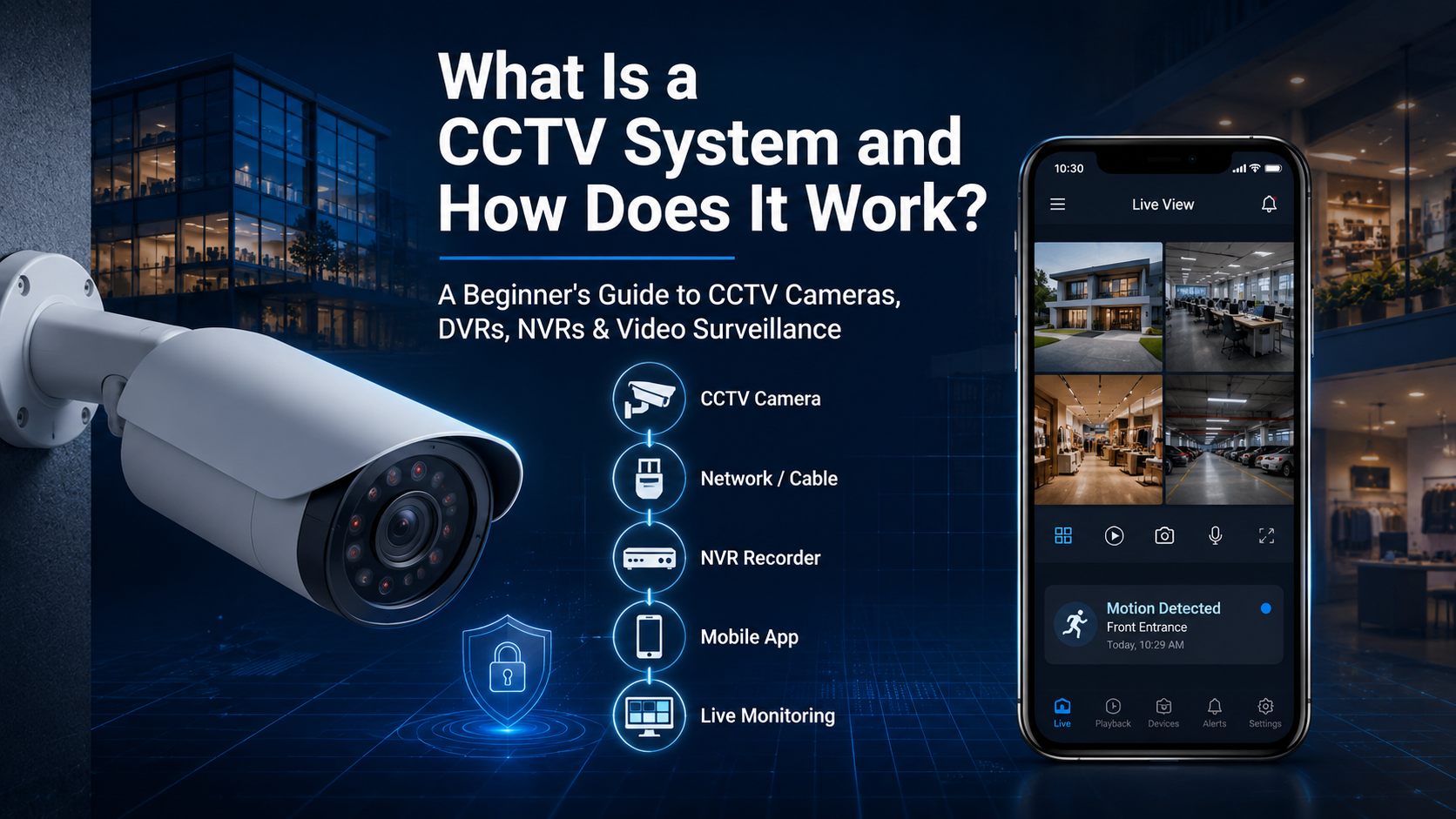
What Is a CCTV System and How Does It Work?
When property owners decide to upgrade their security, the very first question they ask is: exactly what is a CCTV system and how does it work? Understanding these video surveillance system basics is your first step toward building a reliable defense against theft, vandalism, and unauthorized access.
If you are wondering what is a CCTV system, it is a private (Closed-Circuit Television) video surveillance network that uses cameras, recording devices, storage, and monitoring tools to securely capture and manage security footage.
Security professionals use these networks to actively deter crime, monitor daily property activities, and gather vital visual evidence when incidents occur. You will find them installed everywhere, from residential front porches to high-security bank vaults. Whether you need to secure a compact local shop or a massive commercial warehouse, a properly configured setup ensures that your daily video feeds remain secure, private, and strictly controlled.

Talk to Siddu Swami Hiremath
Call our office now: +91-09972047466
Visit us: 50/6 5th main road, 12th Cross Rd, Wilson Garden, Bengaluru, Karnataka 560027
Email: contact@valuablecctvsolution.com
What Is a CCTV System (Closed-Circuit Television)?
To fully grasp the technology and answer what is a CCTV system, you must first understand the true meaning behind the acronym. CCTV stands for Closed-Circuit Television.
Why do engineers call it a “closed circuit”? In a standard television setup, a broadcast tower sends signals out into the open air. Anyone with the right antenna can tune in and watch that feed. A CCTV network does the exact opposite. It creates a completely private, localized loop. The security cameras only transmit video footage to a specific, limited set of dedicated monitors or personal recording devices. No one outside of this closed loop can tune in to view your video feed.
Because of this strict privacy and total user control, property owners rely on these setups across almost every environment. Common examples include:
- Homes: Monitoring front doors, compound walls, and driveways.
- Shops: Preventing shoplifting and overseeing cash registers.
- Offices: Securing private server rooms and tracking visitor access.
- Schools: Ensuring student safety in corridors and playgrounds.
- Apartments: Guarding basement parking lots and main lobby entrances.
If you are asking what is a CCTV system at its core, it is simply your own private, 24/7 digital security guard working exclusively for you.
How Does a CCTV System Work?
Understanding the camera working principle is very straightforward once you know what is a CCTV system. Think of it as a continuous assembly line for video data. Every piece of hardware performs one specific job to move the image from the outside world directly to your screen. The process follows a strict workflow:
Workflow Diagram: Camera → Network → DVR/NVR → Storage → Monitor/Mobile
Cameras Capture Video Footage
The process begins the moment light enters the camera. The internal lens gathers this light and focuses it directly onto a sensitive digital image sensor. This sensor instantly translates the physical light into a raw electronic video signal. Whether someone walks past your front gate in broad daylight or a car pulls into a dark parking lot at night, the lens and image sensor work together to guarantee crisp video capture.
Video Is Transmitted Through Cable or Network
Once the camera generates the video signal, it must send that data to the central recorder. This transmission happens through your network infrastructure. Traditional analog setups push the video through heavy coaxial cables. Modern IP (Internet Protocol) systems transmit digital data using high-speed Ethernet cables. Alternatively, wireless security cameras skip the physical wires entirely and broadcast their video signals over your local Wi-Fi.
DVR or NVR Processes and Stores Video
The central recorder acts as the brain of the operation. When the raw video arrives, the DVR (Digital Video Recorder) or NVR (Network Video Recorder) takes over. The software applies advanced video compression to shrink the file sizes without ruining the image quality. After compression, the recorder writes this data directly onto an internal hard drive. This continuous recording loop ensures you have a secure, long-term storage archive.
Users Monitor Footage
The final step of this working principle puts the video in front of your eyes. The recorder decodes the saved files and outputs the visual data to your viewing devices. A security guard can watch a live feed on a dedicated desk monitor, while a homeowner can open a mobile app to review instant playback of a delivered package.
What Are the Main Components of a CCTV System?
Before you buy any hardware, you must know what pieces you actually need. Every time someone asks what is a CCTV system, they need to understand that it requires these five specific parts to function correctly. If you’re looking for expert implementation, exploring our professional CCTV installation services ensures all these components are integrated flawlessly.
The main components are:
- Cameras
- DVR/NVR
- Network or Cabling
- Storage
- Viewing Device
CCTV Cameras
Security cameras serve as the frontline defense for your property. Manufacturers design different body styles to suit specific environments. Dome cameras feature a discreet, vandal-resistant bubble perfect for indoor ceilings. Bullet cameras stick out prominently to act as a highly visible outdoor crime deterrent. Turret cameras offer versatile, glare-free night vision, while advanced PTZ (Pan-Tilt-Zoom) cameras allow security teams to actively track moving subjects.
DVR or NVR Recorder
The recorder acts as the central hub connecting all your cameras. A DVR processes incoming analog signals, while an NVR handles modern digital IP streams. Both devices perform the exact same core duties: they manage continuous video recording, organize data folders by date and time, facilitate smooth video playback, and handle your overall storage management.
Transmission Infrastructure
To connect the cameras to the recorder, you need a robust transmission infrastructure. Analog setups rely on standard coaxial cables to transmit video. Modern digital installations use Cat6 cables, which offer PoE (Power over Ethernet). PoE allows a single cable to send video data and deliver electricity to the camera simultaneously.
Storage Devices
Your network needs a physical place to dump the continuous stream of video data. Installers typically mount a specialized surveillance HDD (Hard Disk Drive) directly inside the NVR or DVR. These specialized drives spin 24/7 without overheating. Some high-end setups use an SSD (Solid State Drive) for lightning-fast video retrieval. If you are unsure about storage capacity, you can read our comprehensive guide on how long to keep CCTV footage Bangalore to properly size your hard drive.
Viewing Devices
Finally, you need hardware to actually see what your cameras capture. Commercial setups typically connect the recorder directly to a wall-mounted display monitor using an HDMI cable. For residential users and business owners on the go, the recorder connects to the internet, allowing you to stream live video securely to your smartphone or tablet. You can see real-world examples of how these viewing stations look by checking out our project gallery.
DVR vs NVR: What’s the Difference?
To truly answer what is a CCTV system, you must choose between a DVR and an NVR. Both central hubs record and store video, but they handle the technical data differently. For a much deeper dive into the specific cameras these recorders use, you can read our complete analog vs IP cameras comparison.
What Is a DVR?
A DVR (Digital Video Recorder) connects to traditional analog cameras using thick coaxial cables. In this setup, the camera captures the raw analog video and sends it directly to the recorder. The DVR hardware acts as the primary processor, doing all the heavy lifting to digitize, compress, and store the footage.
What Is an NVR?
An NVR (Network Video Recorder) pairs with modern IP (Internet Protocol) cameras. Unlike an analog setup, an IP camera processes and digitizes the video internally before sending it over a network switch to the NVR. This setup uses simple Cat6 cables and supports PoE (Power over Ethernet), delivering data and electricity through one single wire.
Which Is Better?
For most new installations, we strongly recommend IP cameras paired with an NVR. An NVR future-proofs your property, provides superior image clarity, and simplifies the cabling process. However, a DVR remains a budget-friendly option if you are upgrading an older building that already has coaxial cables sealed inside the walls.
Do CCTV Cameras Work Without Internet?
Yes. A major part of understanding what is a CCTV system is knowing that it functions perfectly fine without an active internet connection.
Because a security camera network operates on a strict “closed circuit,” the cameras communicate directly with your central recorder using local cables or a private local Wi-Fi router.
What Works Without Internet:
- Recording: Cameras continuously capture and send video to the DVR or NVR.
- Local Storage: The recorder successfully saves the footage to its internal hard drive.
- Local Monitoring: You can watch live video on a monitor physically plugged into the recorder.
What Needs Internet: You only need internet access if you want to interact with your setup remotely. Without a broadband connection, you lose the ability to use remote mobile viewing, receive push notifications for active motion alerts, or back up critical video evidence to a cloud server.
How Does CCTV Footage Reach Your Mobile Phone?
Property owners frequently ask how their local setup securely broadcasts video to their mobile devices.
The Data Flow: Camera → Recorder → Router → Cloud Service → Mobile App
First, the camera sends the video to your NVR or DVR. The recorder compresses the file and pushes it to your property’s local Wi-Fi router. The router then connects to the camera manufacturer’s secure cloud service over the internet. Finally, the cloud service routes that specific data stream directly to the app on your smartphone.
To protect your privacy during this journey, manufacturers use heavy encryption. Nobody can intercept the video feed. Furthermore, you control secure access through strict user accounts, ensuring that only authorized family members or managers can log in and view your cameras.
Modern CCTV Features Every Buyer Should Know
As you explore what is a CCTV system, you will realize that manufacturers constantly release new technology. To get the best security, you must understand these modern features before you buy.
- Night Vision: Infrared (IR) technology allows cameras to see clearly in total darkness. Modern sensors even capture full-color video at night, guaranteeing 24/7 visibility over your entire property.
- Motion Detection: Instead of recording empty rooms continuously, motion detection triggers the recorder to save data only when physical movement happens. This smart software feature saves massive amounts of storage space.
- Human Detection AI: Basic motion sensors trigger on swaying trees or stray animals. Human detection AI filters out these false alarms and sends alerts only when a real person enters the frame.
- H.265 Video Compression: This advanced video algorithm shrinks heavy video file sizes by up to 50% without dropping the visual quality. It effectively doubles your hard drive storage capacity effortlessly.
Common CCTV Installation Mistakes to Avoid
Even the best hardware fails if you install it incorrectly. Avoid these common mistakes to keep your home or business truly secure. Our engineering team, led by Siddu Swami Hiremath, ensures these pitfalls are avoided during every deployment.
- Poor Camera Placement: Mounting cameras too high makes identifying faces impossible. Pointing them directly into the sun creates a blinding glare that completely ruins the image.
- Ignoring Night Coverage: Many buyers test cameras during the day and forget to check night performance. Without proper infrared capabilities, your property becomes completely vulnerable after dark.
- Insufficient Storage: Pairing eight high-definition cameras with a tiny 1TB hard drive forces the recorder to overwrite video every few days. You will lose critical evidence before you even notice a crime happened.
Real-World Example: We frequently see retail shop owners install basic cameras directly above glass entrance doors. The bright outside daylight washes out the sensor, leaving incoming customer faces as dark shadows. Lowering the camera angle and enabling WDR (Wide Dynamic Range) instantly solves this problem.
Which CCTV System Is Best for Homes and Businesses?
When asking what is a CCTV system best suited for your property, you must match your hardware exactly to your specific environment to get the best results.
- Home Security: Residential properties need simple, reliable perimeter defense. A 4-camera IP setup featuring 2MP or 4MP resolution, infrared night vision, and a mobile app provides excellent security for main gates and driveways.
- Shop Security: Retail owners must monitor cash registers, inventory aisles, and customer interactions closely. Vandal-resistant turret cameras paired with a dedicated NVR holding at least 30 days of storage help prevent shoplifting and resolve billing disputes.
- Office Security: Commercial spaces require scalable, high-grade security. Businesses should invest in robust IP networks using PTZ cameras to monitor large employee entrances and reception areas.
Frequently Asked Questions
Q1. What is a CCTV system?
A CCTV (Closed-Circuit Television) system is a private surveillance network consisting of cameras, cables, a recorder, and a display monitor used to monitor and secure a specific property.
Q2. What are the 4 main components of a CCTV system?
Every functional setup requires four primary parts. These include the security cameras to capture video, the transmission cables or network to send data, a DVR or NVR to process and store footage, and a viewing device like a monitor or smartphone to watch the feeds.
Q3. What is the difference between DVR and NVR?
A DVR connects to older analog cameras using traditional coaxial cables and processes the raw video directly at the recorder. Conversely, an NVR pairs with modern IP cameras over ethernet networks, storing video data that the cameras have already digitized internally.
Q4. Do CCTV cameras need internet?
No, they do not require an internet connection to function. A closed-circuit network easily records and saves video locally to its internal hard drive without any broadband access. You only need the internet if you want to receive mobile alerts or view live footage remotely.
Key Takeaways
Now that you know exactly what is a CCTV system, keep these final points in mind:
- CCTV functions as a highly secure, private surveillance network.
- Security cameras actively capture and transmit vital video footage.
- A central DVR or NVR continuously records and stores the video locally.
- Internet access remains completely optional for local recording.
- Modern NVR setups usually provide the best results for new installations.
Contact Us For Support📞 Call Us: +91-09972047466 Available for urgent security needs & installation support
✉️ Email: contact@valuablecctvsolution.com
📍 Visit Our Office: 50/6 5th main road, 12th Cross Rd, Wilson Garden, Bengaluru, Karnataka 560027
🗺️ Google Maps: Check Our Google My Business Listing for Reviews
Ready to secure your property with the right technology? To learn more about our company values and expertise, visit our About Us page. Or, contact us today at Valuable CCTV Solution for a free consultation to find the perfect video surveillance network for your needs.

Siddu Swami Hiremath is the Founder & CEO of Valuable Security Solution, a Bengaluru-based company specializing in CCTV camera installation, electronic security systems, and surveillance solutions. With over 15 years of hands-on experience in the security industry, he has helped homeowners, businesses, apartments, offices, schools, and industrial facilities implement reliable CCTV systems, access control systems, biometric attendance solutions, fire alarm systems, and burglar alarm systems. His expertise in designing customized security solutions has made Valuable Security Solution a trusted name for CCTV installation in Bangalore. Known for same-day site surveys, professional installation, best-price guarantee, and 24/7 technical support, Siddu is committed to delivering advanced security solutions that ensure long-term safety, protection, and peace of mind.