
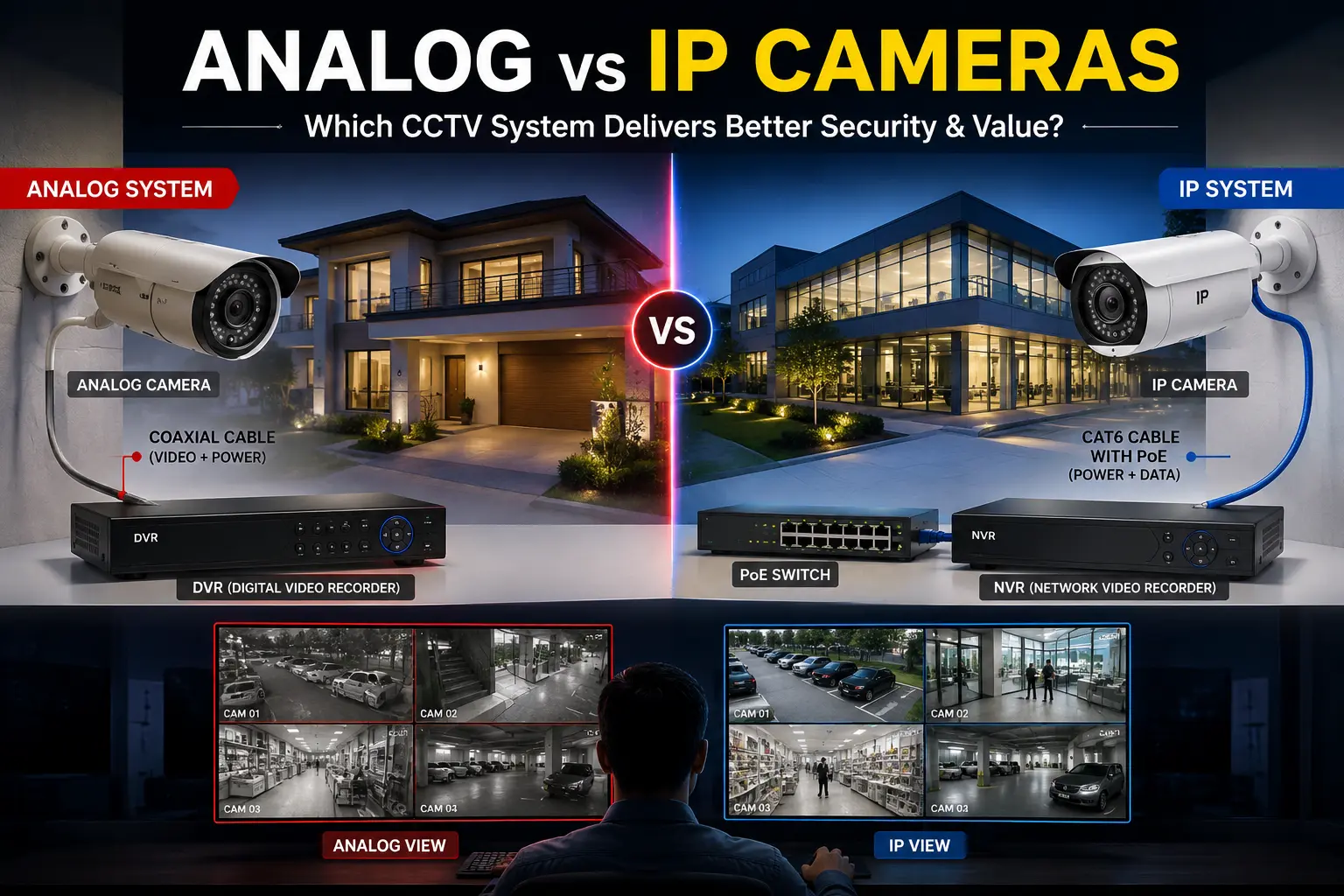
Analog vs IP Cameras: Which is Better for Modern Security in 2026?
You finally decide to upgrade your property’s security. You invite vendors, review estimates, and suddenly face a frustrating dilemma: you hold two vastly different installation quotes. One vendor pitches a budget-friendly traditional analog setup, while the other recommends a premium IP (Internet Protocol) network system. This massive price gap leaves many buyers confused. When comparing analog vs IP cameras, which technology actually protects your property best without wasting your budget?
To make a confident choice, you must understand the core difference between IP and analog CCTV cameras. The primary difference lies in video transmission. Analog cameras send uncompressed, raw video signals over traditional coaxial cables directly to a Digital Video Recorder (DVR). IP cameras digitize the video internally and transmit it over network cables (Ethernet) to a Network Video Recorder (NVR). This digital approach unlocks higher resolutions, advanced AI analytics, and streamlined Power over Ethernet (PoE).
At Valuable CCTV Solution, we manage professional IP camera installation in Bangalore daily. We help facility managers and homeowners cut through the technical jargon to select the right fit from our comprehensive security solutions. Let’s break down the engineering specs and the true long-term costs so you can choose the right system.
What is the Core Difference Between IP and Analog CCTV Cameras?
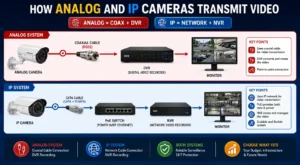
Before comparing system prices, evaluating analog vs IP cameras requires a clear understanding of how each technology processes video data.
How Analog (HD-over-Coax) Works
An analog security system relies on a direct, point-to-point physical connection. The camera captures raw video and pushes it directly through a coaxial cable to a Digital Video Recorder (DVR). The DVR receives the signal, digitizes it, compresses the file, and stores it. Do not mistake modern analog for the grainy VHS tapes of the past. Today’s HD-over-coax systems—like HD-TVI and HD-CVI—push crisp video up to 5 Megapixels. However, the DVR still does all the heavy computing.
How IP (Internet Protocol) Works
When weighing network cameras vs traditional CCTV, think of an IP camera as a dedicated miniature computer. Instead of sending raw video, the IP camera digitizes and compresses the footage internally using advanced H.265+ technology. It then transmits these organized digital data packets across a Local Area Network (LAN) using a standard Cat6 Ethernet cable. Because the camera handles the processing itself, it easily supports heavy 4K resolutions without crashing your network.
Analog vs IP Cameras: 4 Engineering Differences Compared
When you evaluate an analog vs IP camera comparison, the true value of your investment hinges on four core engineering metrics. Let’s break down exactly what you get for your money.
1. Resolution and Image Clarity
Resolution determines whether you capture a blurry silhouette or a readable license plate. Analog cameras measure legacy resolution in TV Lines. While modern HD analog pushes up to 5 Megapixels, it struggles heavily with digital zoom. The image pixelates rapidly when you attempt to magnify a distant face.
IP cameras utilize Progressive Scan CMOS sensors to capture native 4K (8 Megapixels) and beyond. Because the camera digitally compresses high-definition footage on the device, you retain crisp, actionable detail even when zooming in on your recorded playback.
2. Cabling Infrastructure (Coaxial vs. PoE)
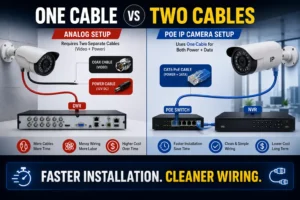
The physical wiring drives a massive portion of your installation costs. When comparing coaxial vs ethernet security cameras, analog systems rely on bulky RG59 Siamese cables. Installers must pull two separate wires to every single camera location: one for the video signal and another connected to a localized power supply.
IP cameras eliminate this headache entirely using Power over Ethernet (PoE). Installers run a single Cat6 network cable from a PoE switch directly to the camera, delivering both high-speed data and electrical power simultaneously. This drastically reduces wall-drilling and speeds up your deployment.
3. Smart Features and AI Analytics
A modern security system should actively prevent incidents, not just record them. This reveals one of the biggest IP camera advantages. Analog DVRs rely on basic pixel-based motion detection, which triggers frustrating false alarms every time a stray dog walks by or a tree branch blows in the wind.
Conversely, IP cameras process artificial intelligence at the “edge”—meaning the camera’s internal microchip analyzes the video instantly. This edge computing enables enterprise-grade features like Automatic Number Plate Recognition (ANPR), human-vehicle classification, and digital line-crossing detection. You receive precise alerts while filtering out environmental noise.
4. Scalability and Network Integration
Physical hardware limits dictate how easily you can expand your surveillance coverage. An 8-channel analog DVR contains exactly eight physical ports on the back of the machine. If you need a ninth camera, you must buy an entirely new recorder.
IP systems operate flexibly over your network infrastructure. You can add a new camera simply by plugging it into the nearest network switch on your Local Area Network (LAN), without running a new cable all the way back to the main recorder.
Quick Reference: Analog vs. IP Technologies
| Feature | Analog System (HD-over-Coax) | IP System (Network/PoE) |
| Resolution | Reaches up to 5MP but loses detail on digital zoom. | Native 4K and beyond with crystal clear digital zoom. |
| Cabling | Requires two separate wires (coaxial data plus power). | Uses one Cat6 cable for both data and power (PoE). |
| Smart Analytics | Basic motion detection triggers frequent false alarms. | Edge AI processes license plates and human detection accurately. |
| Scalability | Strictly limited by the physical ports on the DVR. | Scales easily using existing network switches and LAN bandwidth. |
The True Cost of Ownership for Analog vs IP Cameras: 5-Year Breakdown
Do not make your security decision based solely on the upfront installation quote. When buyers ask why are IP cameras more expensive than analog, they usually only look at the hardware price tag. To make a smart investment, you must evaluate the true 5-year cost difference between IP and analog cameras, factoring in labor, data storage, and ongoing maintenance.
Upfront Hardware and Labor
When looking strictly at shelf pricing, the comparison between analog vs IP cameras heavily favors traditional setups, as analog hardware easily wins the initial cost battle. However, labor costs often balance this out. Because IP systems utilize single-cable PoE technology, technicians spend far less time routing dual cables and drilling walls, reducing your initial installation bill.
Storage Costs and Efficiency
Video storage forms a massive hidden expense. Analog DVRs process heavy, uncompressed video files that rapidly consume specialized surveillance hard drives like WD Purple or Seagate SkyHawk. Conversely, IP cameras compress footage internally using advanced H.265+ technology before sending it over the network. This digital compression cuts your storage requirements in half. You ultimately buy fewer hard drives because your system holds twice as much footage on the exact same disk space.
Maintenance and Expansion
IP systems deliver superior long-term savings through easier maintenance. Security engineers can troubleshoot many IP network conflicts remotely, saving you the cost of a physical site visit. Furthermore, when your business expands, adding a new IP camera simply requires plugging into the nearest network switch. An analog system demands an expensive, brand-new cable run spanning your entire building back to the central DVR.
The Hybrid Solution: How to Upgrade from Analog to IP Cameras Without Rewiring
Many property owners wonder, can I use analog cameras with an NVR, or do I have to throw away my entire existing system? If you have a functioning but outdated analog setup, you do not have to rip open your walls to install new network cables. The security industry solved this expensive upgrade bottleneck, turning the choice between analog vs IP cameras into a balanced, gradual transition through hybrid solutions.
Enter the Penta-brid DVR, often called an XVR. Leading manufacturers engineered these smart recorders to bridge the gap between legacy and modern technology. An XVR automatically detects and accepts video signals from both traditional coaxial cables and modern IP network cameras simultaneously.
This flexibility allows you to execute a budget-friendly upgrade. You can keep your existing analog cameras in low-risk areas—like internal hallways or back offices—while installing high-definition 4K IP cameras with advanced AI at critical zones, such as your main gate, parking barrier, or cash register.
As an insider engineering tip, if you must install an IP camera where an old analog camera sits but cannot drill for a new Cat6 cable, ask your installer about Ethernet-over-Coax (EoC) converters. These clever devices transmit digital IP data directly over your old analog wiring, saving you immense labor and repainting costs.
Local Considerations for IP Camera Installation in Bangalore
When you design a security system, your local environment directly dictates its performance. A camera setup built for a generic indoor office might fail completely during a heavy storm. When planning an IP camera installation in Bangalore, you must account for three critical local factors.
Building Architecture and Cabling
Bangalore features a unique mix of older, thick-walled independent houses in Jayanagar and ultra-modern commercial facilities in Whitefield. If you retrofit a legacy home, thick brick walls heavily disrupt wireless signals and make drilling for new Cat6 cables incredibly difficult. In these scenarios, utilizing a hybrid XVR system saves immense labor. You can review our portfolio of security installations to see how cleanly we handle these tough architectural challenges. Conversely, new tech parks possess existing LAN infrastructure, making a pure IP system the most logical choice.
Managing BESCOM Power Fluctuations
Frequent BESCOM power cuts and voltage drops easily damage sensitive NVR hard drives and corrupt IP data packets. You must install centralized UPS backups to keep your PoE switches and recording units perfectly stable during blackout transitions.
Monsoon Weather Readiness
Bangalore’s heavy, unpredictable monsoons destroy cheap hardware. Always insist your installer uses IP67-rated waterproof cameras for outdoor perimeters. Furthermore, technicians must seal every exterior Cat6 junction box perfectly. If rainwater seeps into the network connectors, it causes immediate signal loss and expensive short circuits.
Final Verdict: Which is Better for Your Security Setup?
Your final decision in the debate of analog vs IP cameras depends entirely on your specific property layout, operational goals, and available budget.
Choose an Analog System If:
-
You are operating on a strict budget and need basic, passive perimeter monitoring.
-
You already have functioning coaxial cabling safely installed in your building’s walls.
-
You only need a few cameras for a small retail shop or simple home interior.
Choose an IP System If:
-
You are deciding which is better for home security analog or IP for a large, modern villa or sprawling commercial facility.
-
You require the best CCTV camera for small business Bangalore setups featuring facial recognition, sharp digital zoom, or automated gate alerts.
-
You want a future-proof network infrastructure that scales seamlessly as your operations grow.
Secure Your Property with Valuable CCTV Solution
Choosing the right surveillance technology depends entirely on your site’s physical layout. Every property has unique blind spots and cabling challenges. Don’t guess with your security by relying on generic, off-the-shelf kits that fail when you need them most.
Instead, rely on local expertise from our experienced security architects to protect what matters. Contact the engineering team at Valuable CCTV Solution for a comprehensive site audit in Bangalore. We’ll evaluate your premises, assess your current infrastructure, and recommend the perfect tailored system to keep your business or home completely secure.
Contact Us For Support
📞 Call Us: +91-09972047466 Available for urgent security needs & installation support
✉️ Email: contact@valuablecctvsolution.com
📍 Visit Our Office: 50/6 5th main road, 12th Cross Rd, Wilson Garden, Bengaluru, Karnataka 560027
🗺️ Google Maps: Check Our Google My Business Listing for Reviews

Siddu Swami Hiremath is the Founder & CEO of Valuable Security Solution, a Bengaluru-based company specializing in CCTV camera installation, electronic security systems, and surveillance solutions. With over 15 years of hands-on experience in the security industry, he has helped homeowners, businesses, apartments, offices, schools, and industrial facilities implement reliable CCTV systems, access control systems, biometric attendance solutions, fire alarm systems, and burglar alarm systems. His expertise in designing customized security solutions has made Valuable Security Solution a trusted name for CCTV installation in Bangalore. Known for same-day site surveys, professional installation, best-price guarantee, and 24/7 technical support, Siddu is committed to delivering advanced security solutions that ensure long-term safety, protection, and peace of mind.