
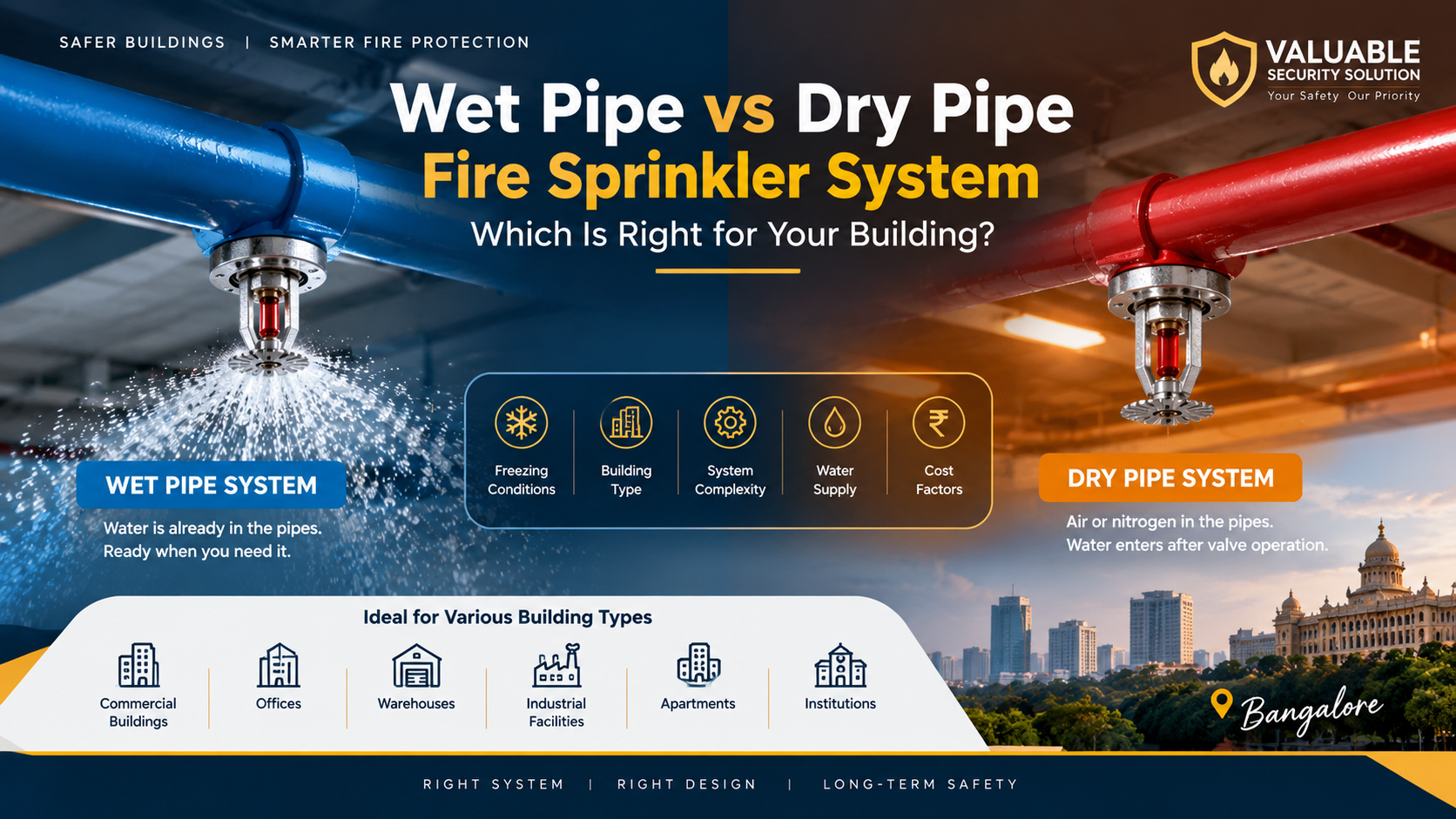
Wet Pipe vs Dry Pipe Fire Sprinkler System: Which Is Right for Your Building?
A wet pipe system holds water constantly in its pipes, immediately discharging upon activation. A dry pipe system maintains pressurized air or nitrogen in the pipes until operation, allowing water to enter only when triggered. Choosing a Wet Pipe vs Dry Pipe Fire Sprinkler System depends on building use, hazards, ambient temperature, water supply, and design requirements. Valuable Security Solution evaluates Bangalore properties to design the optimal fire safety setup.
Wet Pipe vs Dry Pipe Fire Sprinkler System: What Is the Difference?
A wet pipe system stores water directly within the piping network for immediate release. A dry pipe system holds pressurized air or nitrogen in the pipes, allowing water to flow only after a sprinkler head opens and the internal air pressure drops.
Wet Pipe vs Dry Pipe Comparison
| Factor | Wet Pipe | Dry Pipe |
| Pipe condition | Filled with water | Filled with air/nitrogen |
| Water availability | Already in piping | Enters after valve operation |
| Main consideration | Suitable where freezing isn’t a concern | Useful where water-filled pipes are unsuitable |
| System complexity | Generally simpler | More complex |
| Typical environment | Normal conditioned spaces | Freezing/unheated areas where appropriate |
| Main control arrangement | Wet-pipe valve arrangement | Dry-pipe valve |
Understanding these differences is critical for building owners navigating Fire Sprinkler System Types. A Wet Pipe Fire Sprinkler System delivers faster water application and requires less maintenance, making it the standard for conventional buildings. However, a Dry Pipe Fire Sprinkler System protects infrastructure in environments where ambient temperatures would freeze standing water, causing pipe bursts and system failures.
What Is a Wet Pipe Fire Sprinkler System?
How Does a Wet Pipe Sprinkler System Work?
When a fire breaks out, the ambient heat rises and reaches the sprinkler head. The individual sprinkler operates once its heat-sensitive element reaches a specific temperature, and water immediately discharges onto the fire. Only the sprinkler heads directly exposed to sufficient heat activate, minimizing unnecessary water damage across the property.
Where Is a Wet Pipe Sprinkler System Suitable?
Wet pipe systems are the standard choice for environments with controlled climates. They are suitable for:
-
Offices
-
Commercial buildings
-
Retail spaces
-
Hotels
-
Apartments
-
Other suitable conditioned spaces
Advantages and Limitations
Advantages:
-
Straightforward system arrangement.
-
Water is already present for immediate discharge.
-
Generally simpler system with fewer moving parts.
Limitation:
-
Water-filled piping cannot be exposed to conditions where freezing is a concern. According to IS 15105, wet-pipe systems must only be installed in areas where there is no danger of the water freezing.
What Is a Dry Pipe Fire Sprinkler System?
How Does a Dry Pipe Sprinkler System Work?
The operation follows a specific sequence: heat from a fire causes the individual sprinkler head to open. The pressurized air or nitrogen inside the pipes escapes, causing the internal pressure to drop. This pressure change operates the dry-pipe valve, allowing water to enter the piping network and finally discharge through the open sprinkler head.
Where Is a Dry Pipe Sprinkler System Used?
Dry pipe systems are engineered for environmental conditions that prohibit standing water. They are utilized in:
-
Unheated spaces
-
Freezing-prone areas
-
Cold-storage environments
-
Certain industrial applications
-
Loading and parking areas where appropriate
Advantages and Limitations
Advantages:
-
Avoids keeping water throughout the piping during standby, eliminating freezing risks.
-
Highly effective where standard wet pipe systems would fail due to environmental constraints.
Limitations:
-
More complex controls and valve arrangements.
-
Requires pressurized air or nitrogen equipment (compressors).
-
Additional maintenance considerations for the air supply and dry-pipe valve.
-
Water has to travel through the piping after system operation, causing a brief delay in discharge.
Wet Pipe vs Dry Pipe: Which System Is Better for Your Building?
Neither system is universally better. A wet pipe system is suitable where water-filled piping is appropriate, while a dry pipe system must be considered where environmental conditions make a wet system unsuitable.
Wet Pipe May Be Suitable When:
-
The building is normally conditioned.
-
Freezing isn’t a concern.
-
The standard commercial occupancy applies.
-
An appropriate water supply exists.
Dry Pipe May Be Suitable When:
-
Freezing is possible.
-
The space is unheated.
-
Cold-storage conditions exist.
-
Project conditions make water-filled piping unsuitable.
What If a Building Has Different Conditions in Different Areas?
Large properties frequently feature mixed environments, such as conditioned office areas, open parking structures, standard warehouses, cold rooms, and unheated service areas. System selection can be area-specific based on design requirements. A single property can utilize a wet pipe system for its office block while deploying a dry pipe system for its cold-storage facility or exposed loading docks.
What Factors Determine the Right Fire Sprinkler System?
Selecting the correct system requires a thorough engineering evaluation based on several critical criteria:
-
Building Occupancy: The specific use of the space, including office, retail, warehouse, industrial, residential, or institutional purposes.
-
Fire Hazard: The nature of the materials present, storage configurations, and daily activities.
-
Temperature and Environmental Conditions: Whether water-filled pipes can remain suitable without the risk of freezing or boiling.
-
Building Layout: Floor area, ceiling height, storage arrangement, and necessary pipe routing paths.
-
Water Supply: Available pressure, flow rates, tank capacity, and fire pump requirements.
-
Existing Fire Protection Systems: Integration with current hydrants, fire alarms, pumps, tanks, and existing sprinkler infrastructure.
-
Applicable Standards and Project Requirements: Alignment with local building codes and IS 15105, which governs the design and installation of fixed automatic sprinkler fire-extinguishing systems in India.
Wet Pipe vs Dry Pipe Sprinkler System Cost
What Affects Wet Pipe System Cost?
-
Sprinkler quantity
-
Piping material and length
-
Control valves
-
Water supply infrastructure
-
Fire pumps
-
Building size
-
Installation complexity
What Affects Dry Pipe System Cost?
A dry pipe system includes all of the cost factors above, plus:
-
Dry-pipe valve arrangement
-
Air/nitrogen equipment (compressors)
-
Additional pressure monitoring controls
-
Increased overall system complexity
Is Dry Pipe More Expensive Than Wet Pipe?
Yes, a dry pipe sprinkler system is generally more expensive to install and maintain than a wet pipe system due to the required air compressors, specialized dry-pipe valves, and complex control mechanisms.
→ Read more: Fire Sprinkler System Installation in Bangalore: Types, Cost & Process
What Is Included in Wet Pipe and Dry Pipe Sprinkler Installation?
Common Components
-
Sprinkler heads
-
Pipe network
-
Control valves
-
Water supply
-
Pressure gauges
-
Flow monitoring devices
-
Fire pump and water storage where required
Additional Dry Pipe Components
-
Dry-pipe valve
-
Pressurized air/nitrogen arrangement
-
Associated supervisory controls
Installation Workflow
Professional installation follows a strict sequence:
Site assessment → System selection → Design → Material selection → Installation → Testing → Commissioning.
Wet Pipe vs Dry Pipe Sprinkler Systems for Commercial Buildings in Bangalore
Offices and Commercial Spaces
Due to Bangalore’s moderate climate and the conditioned nature of modern office spaces, a wet pipe system is overwhelmingly the standard choice, offering reliable protection without freezing concerns.
Warehouses and Storage Buildings
Sprinkler protection for storage facilities varies according to storage practices, roof height, and material type, with designs aligned to IS 15105. A standard wet pipe system often suffices, but cold-storage areas require dry pipe integration.
Industrial Properties
Manufacturing and industrial properties demand a detailed hazard and design assessment. The presence of specialized machinery, unheated processing areas, or specific chemical hazards dictates whether wet or dry systems (or a combination) are implemented.
Existing Buildings in Bangalore
Retrofitting involves assessing the existing ceiling structure, feasible pipe routing, occupied premises constraints, and the capacity of existing pumps, tanks, and fire protection infrastructure.
How to Choose a Fire Sprinkler System Company in Bangalore
What Should a Professional Company Assess?
-
Property type
-
Occupancy classifications
-
Fire risk and hazards
-
Building layout
-
Environmental conditions
-
Existing fire infrastructure
-
Water supply parameters
-
Applicable code requirements
What Should Be Included in the Quotation?
-
Proposed system type
-
Sprinkler quantity
-
Piping network
-
Valve assemblies
-
Pumps and water supply scope
-
Installation labor
-
Testing procedures
-
Commissioning
-
Documentation
-
Maintenance and support
Questions to Ask Before Selecting a Company
-
Why are you recommending wet or dry pipe?
-
Has the site been assessed?
-
What components are included?
-
Is design included?
-
Is testing included?
-
Is commissioning included?
-
What maintenance support is available?
Wet Pipe & Dry Pipe Fire Sprinkler System Installation in Bangalore by Valuable Security Solution
Understanding the Property Requirement
Valuable Security Solution conducts thorough consultations to discuss your property type, building layout, specific fire protection requirements, existing infrastructure, and the intended system scope to ensure accurate planning.
Planning the Appropriate System
Our approach connects property assessment directly to wet/dry system consideration, leading to precise system design and strict adherence to installation requirements.
Installation, Testing & Commissioning
We manage the complete service journey, ensuring seamless execution through Installation → Testing → Commissioning → Handover → Support.
Fire Sprinkler Solutions for Bangalore Properties
Valuable Security Solution provides targeted installations for commercial buildings, offices, shops, warehouses, industrial properties, and institutional properties where applicable.
Why System Selection Matters Before Fire Sprinkler Installation
Choosing a sprinkler system based only on price or popularity can lead to an unsuitable installation. The system should be evaluated against the property’s occupancy, hazard, environmental conditions, water supply, layout, and applicable design requirements. Securing safety relies on a proven sequence: Correct assessment → Correct system type → Correct design → Correct installation → Reliable performance.
FAQs About Wet Pipe and Dry Pipe Sprinkler Systems
What is the difference between a wet pipe and dry pipe sprinkler system?
A wet pipe system keeps water constantly inside the pipes for immediate release. A dry pipe system keeps pressurized air in the pipes, allowing water to enter and discharge only after a sprinkler head operates.
Which is better, wet pipe or dry pipe sprinkler system?
Neither is universally better. Wet pipe is ideal for standard, conditioned environments because of its simplicity and speed. Dry pipe is necessary for unheated or cold-storage areas where water would freeze inside the pipes.
What is a Wet Pipe Fire Sprinkler System?
It is a fire suppression system where the piping is continuously filled with pressurized water. When a fire’s heat activates a sprinkler head, water discharges instantly onto the affected area.
What is a Dry Pipe Fire Sprinkler System?
It is a fire suppression system filled with pressurized air or nitrogen instead of water. When activated by heat, the air escapes, a valve opens, and water fills the pipes to suppress the fire.
Where is a dry pipe sprinkler system used?
Dry pipe systems are used in environments prone to freezing where water cannot sit in the pipes. Common applications include unheated warehouses, commercial freezers, loading docks, and exposed parking garages.
Is a wet pipe sprinkler system suitable for commercial buildings?
Yes. Wet pipe systems are the standard and most reliable choice for commercial buildings, offices, retail stores, and hotels that maintain climate-controlled environments without freezing risks.
Is a dry pipe sprinkler system more expensive?
Yes, a dry pipe system typically costs more due to the added complexity of dry-pipe valves, air compressors, specialized monitoring controls, and higher long-term maintenance requirements.
Can different sprinkler system types be used in the same building?
Yes. Large properties frequently utilize zoned systems. A building might use a wet pipe system for its heated office spaces and a dry pipe system for its unheated loading docks or cold-storage areas.
What standard is used for sprinkler system design in India?
The Bureau of Indian Standards (BIS) uses IS 15105 for the design and installation of fixed automatic sprinkler fire-extinguishing systems, detailing specific requirements for hazards, water supply, and system types.
How do I choose a fire sprinkler system company in Bangalore?
Choose a provider that conducts a thorough site assessment of your occupancy, fire risks, and water supply. Ensure their quotation transparently covers design, specific components, installation, testing, commissioning, and maintenance support.
Need Help Choosing the Right Fire Sprinkler System in Bangalore?
Planning a fire sprinkler system for a commercial, warehouse, industrial, or other property in Bangalore? Valuable Security Solution can help you discuss your property’s specific requirements and determine the appropriate installation scope.
Call Us: +91-09972047466 Available for urgent security needs & installation support
Email: contact@valuablecctvsolution.com
Visit Our Office: 50/6 5th main road, 12th Cross Rd, Wilson Garden, Bengaluru, Karnataka 560027
Google Maps: Check Our Google My Business Listing for Reviews

Siddu Swami Hiremath is the Founder & CEO of Valuable Security Solution, a Bengaluru-based company specializing in CCTV camera installation, electronic security systems, and surveillance solutions. With over 15 years of hands-on experience in the security industry, he has helped homeowners, businesses, apartments, offices, schools, and industrial facilities implement reliable CCTV systems, access control systems, biometric attendance solutions, fire alarm systems, and burglar alarm systems. His expertise in designing customized security solutions has made Valuable Security Solution a trusted name for CCTV installation in Bangalore. Known for same-day site surveys, professional installation, best-price guarantee, and 24/7 technical support, Siddu is committed to delivering advanced security solutions that ensure long-term safety, protection, and peace of mind.