
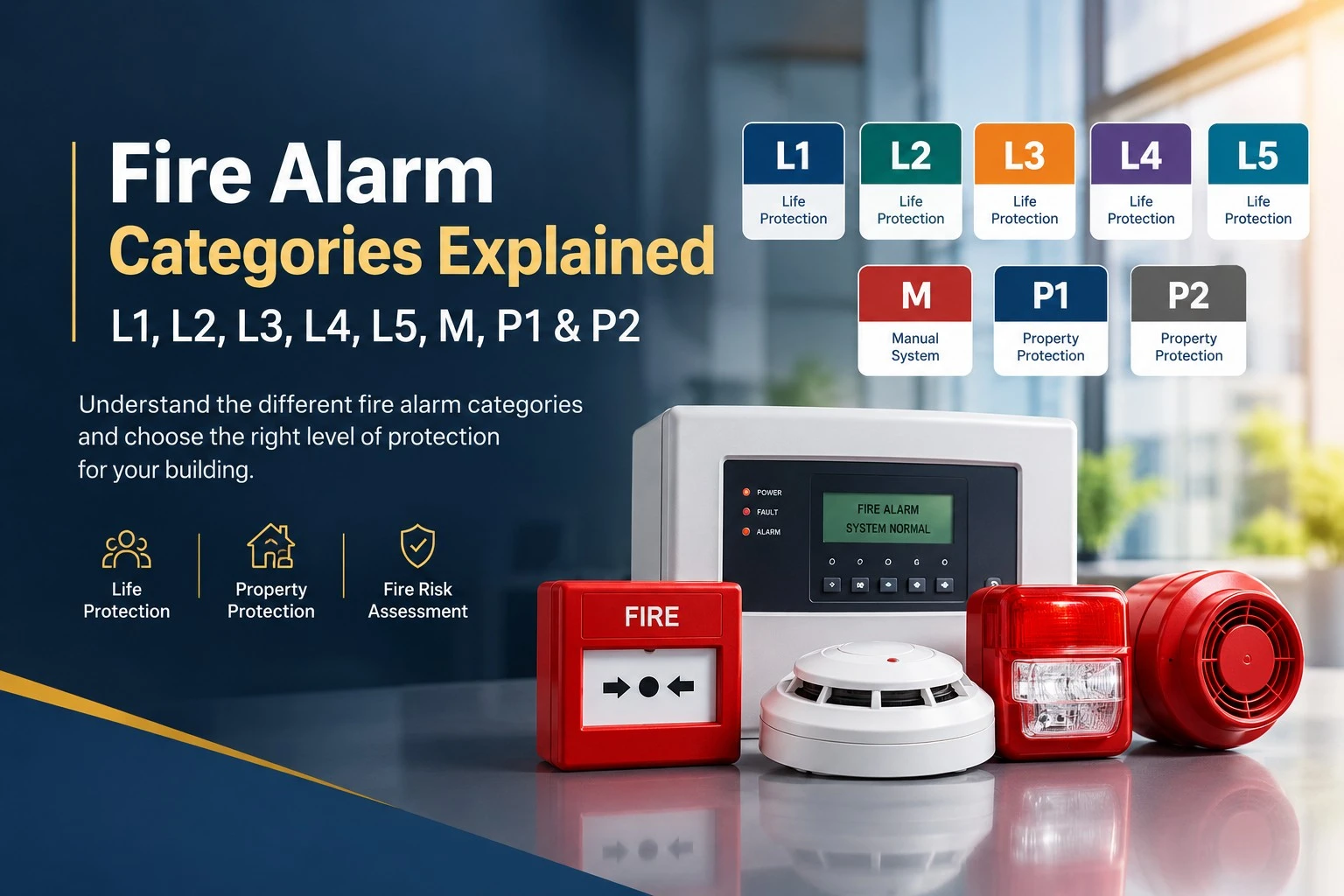
Fire Alarm Categories Explained: L1, L2, L3, L4, L5, M, P1 & P2
When planning a fire safety strategy for a building, selecting the right equipment is only part of the process. You must also determine the appropriate fire alarm categories for your property. These categories do not describe the brand of the panel or the specific type of smoke detector used. Instead, they define the fundamental protection objective and the exact extent of fire detection coverage required throughout the premises.
Broadly, fire alarm systems are grouped into three main families: L Categories for life protection, P Categories for property protection, and Category M for manual fire alarms. The numerical classifications, such as L1 through L5, identify where automatic detection is placed and what specific safety goals that coverage is designed to achieve.
What are fire alarm categories?
Fire alarm categories classify a fire alarm system according to its protection objective and the extent of fire detection coverage. Common categories include L1–L5 for life protection, P1–P2 for property protection, and M for manual alarm systems.
What Do Fire Alarm Categories Mean?
A fire alarm category dictates the physical spread and intent of your detection network. Because different buildings present completely different risks, evacuation challenges, and occupancy levels, two commercial properties of the exact same size may require entirely different fire alarm categories.
A common mistake is confusing the fire alarm classification with the actual hardware technology being installed. To plan a system correctly, you must separate the protection objective from the equipment type.
Fire Alarm Category ≠ Fire Alarm System Type
| Term | What it describes |
| Fire Alarm Category | The protection objective and the physical extent of detection coverage (e.g., L1, P2). |
| Conventional System | A system type where devices are wired in simple zones. |
| Addressable System | A system type where individual devices are digitally identified on a loop. |
| Wireless System | A system type where devices communicate via radio frequencies. |
| Detector Type | The specific hardware used to sense an emergency (e.g., smoke, heat, carbon monoxide). |
The 3 Main Fire Alarm Category Groups
Understanding fire alarm system categories begins with identifying the primary goal of the installation. All systems fall into one of three overarching groups.
Category L — Life Protection
Category L systems are designed explicitly to protect building occupants. They achieve this through automatic fire detection placed in strategic locations to provide the earliest possible warning, allowing people enough time to evacuate safely. The L category group is subdivided into L1, L2, L3, L4, and L5.
These numbers do not represent a simple “good, better, best” ranking. Rather, they represent different detection objectives and coverage arrangements tailored to specific building risks.
Category P — Property Protection
Category P systems focus on the protection of property and physical assets rather than solely on human life. The goal is early detection to summon the fire brigade quickly, thereby minimizing fire damage and ensuring business continuity. This group is divided into P1 and P2.
Category M — Manual Fire Alarm
Category M systems rely entirely on human discovery of a fire. Warning the building’s occupants requires someone to physically operate a manual call point. Unlike L and P categories, a Category M fire alarm does not feature automatic fire detection.
L1, L2, L3, L4 & L5 Fire Alarm Categories Explained
For buildings requiring life protection, the L classification determines exactly which areas of the property must have automatic fire detection installed.
What Is an L1 Fire Alarm System?
What is an L1 fire alarm system?
An L1 fire alarm system provides the maximum level of life protection through automatic fire detection. It requires smoke or heat detectors to be installed in all areas of a building, including roof spaces and voids, to ensure the earliest possible warning of a fire.
-
What is it? The most comprehensive life protection category available.
-
What areas are normally covered? Virtually the entire building, including offices, storage rooms, corridors, stairwells, and accessible voids.
-
What is its main safety objective? To provide the absolute earliest warning of a fire, regardless of where it starts.
-
What type of building/risk may call for it? Large residential care homes, hospitals, and large hotels where occupants may be sleeping, vulnerable, or require significant time to evacuate.
-
How is it different from the next category? Unlike L2, an L1 fire alarm system leaves almost no area of the building without automatic detection.
What Is an L2 Fire Alarm System?
-
What is it? An enhanced life protection system that covers all escape routes plus specific high-risk areas.
-
What areas are normally covered? Corridors, stairways, and rooms opening onto escape routes, alongside identified higher-risk spaces like kitchens, boiler rooms, or heavy plant rooms.
-
What is its main safety objective? To secure the escape routes while providing early detection in rooms where a fire is statistically most likely to start.
-
What type of building/risk may call for it? Medium-to-large office buildings or factories with specific hazardous areas.
L1 vs L2: What changes?
While an L1 system covers the entire building, an L2 system restricts automatic detection to escape routes and adjoining rooms, plus specifically identified high-risk areas, leaving low-risk rooms without automatic detectors.
What Is an L3 Fire Alarm System?
-
What is it? A standard life protection category focused heavily on evacuation paths.
-
What areas are normally covered? All escape routes (corridors and staircases) and all rooms that open directly onto those escape routes.
-
What is its main safety objective? To provide enough early warning so that occupants can evacuate before their designated escape route becomes filled with smoke.
-
What type of building/risk may call for it? Standard commercial applications. For example, a multi-room office building where fire detection needs to provide a warning before an escape corridor becomes impassable.
-
How is it different from the next category? L3 places detectors in the rooms adjoining the escape routes, whereas L4 only places detectors in the escape routes themselves.
What Is an L4 Fire Alarm System?
-
What is it? A basic life protection system that provides a limited, focused scope of automatic fire detection.
-
What areas are normally covered? Only the designated escape routes, such as main corridors and stairwells.
-
What is its main safety objective? To warn people if a fire is threatening the primary paths used for evacuation.
-
What type of building/risk may call for it? Lower-risk commercial properties with simple layouts where a fire starting in an adjoining room would be easily noticed before threatening the escape path.
Is L4 better than L3?
No. They are designed for different coverage objectives; the appropriate category depends on the identified risk, building layout, and required occupant protection.
What Is an L5 Fire Alarm System?
-
What is it? A bespoke life protection category designed to satisfy a specific fire safety objective identified during a fire risk assessment.
-
What areas are normally covered? Highly targeted areas based entirely on the building’s unique risks.
-
What is its main safety objective? To mitigate a specific hazard that does not fit neatly into the L1–L4 classifications.
-
What type of building/risk may call for it? A building that generally only requires a Category M (manual) system, but features a specific automated server room that requires local automatic detection.
-
How is it different from the other categories? L5 is not simply “L4 but less.” It is a custom, localized fire alarm protection strategy. It can often be used alongside another category (e.g., an L3 system with an L5 addition for a specific hazardous chemical storage room).
What Is a Category M Fire Alarm System?
What is a Category M fire alarm?
A Category M fire alarm is a manual system that relies entirely on human intervention. It features manual call points and sounders, but contains no automatic fire detection devices like smoke or heat detectors.
In a Category M fire alarm system, the alarm is only raised when a person discovers a fire and breaks the glass on a manual call point. Because it lacks automatic fire detection, it is typically only appropriate for basic, low-risk workplaces where occupants are awake, actively moving around, and able to spot a fire immediately. It is fundamentally different from L categories, which activate automatically without human input.
What Are P1 and P2 Fire Alarm Categories?
While L categories focus on saving lives, P categories exist to save buildings. A property protection fire alarm is installed to minimize structural damage and limit business interruption by ensuring the fire brigade is alerted as fast as possible.
What Is a P1 Fire Alarm System?
A P1 fire alarm provides broad property detection coverage. Automatic fire detectors are installed throughout all areas of the building. The goal is the earliest possible detection of a fire anywhere on the premises. This is typically implemented in high-value environments, critical facilities, large warehouses, or industrial properties where a fire could cause catastrophic financial or operational loss.
What Is a P2 Fire Alarm System?
A P2 fire alarm system provides targeted property protection. Instead of covering the entire building, automatic detection is installed only in specific high-risk or critical areas. This might include server rooms, heavy plant areas, or vital storage facilities.
Note that P1 is not inherently “better” than P2. They serve different coverage objectives. The appropriate option depends entirely on the property’s specific asset risks and protection needs.
L1 vs L2 vs L3 vs L4 vs L5 Fire Alarm Categories
To simplify the differences between the life protection classifications, use this comparison table to understand how detection coverage scales based on the objective.
| Category | Main objective | Detection approach | Best understood as |
| L1 | Extensive life protection | Broad building coverage | Maximum life-protection objective |
| L2 | Additional life protection | Escape routes + identified higher-risk areas | Enhanced protection |
| L3 | Life protection | Escape routes + relevant adjoining rooms | Evacuation-focused protection |
| L4 | Basic life protection | Escape routes only | Limited coverage |
| L5 | Specific life-safety objective | Targeted area/risk | Bespoke protection |
L Category vs P Category vs M Category — What Is the Difference?
You can easily separate the three main fire alarm category groups by asking three simple questions regarding the system’s primary function:
-
Category L (Who are we primarily protecting?)
We are protecting people and occupants. L = Life.
-
Category P (What are we primarily trying to protect?)
We are protecting property, assets, and business continuity. P = Property.
-
Category M (How is the alarm raised?)
The alarm is raised manually by a person. M = Manual.
How Is the Right Fire Alarm Category Determined?
You cannot simply choose an L2 fire alarm system because it fits a budget, or assume L3 is correct just because a building is an office. The appropriate fire alarm classification is determined by evaluating several critical factors.
Building Use
The primary function of the property dictates the baseline risk. An office, a primary school, a luxury hotel, an industrial warehouse, and a residential apartment block all require vastly different detection strategies based on how the building is used daily.
Occupancy
The number of people inside matters, but so does their state. Sleeping occupants (in hotels or hospitals) require much earlier warning than awake occupants. Furthermore, visitor or public access areas require more robust coverage than restricted staff-only zones, especially if occupants are unfamiliar with the exits.
Fire Risk
Different rooms present different ignition risks. Commercial kitchens, high-voltage electrical rooms, manufacturing plant rooms, and chemical storage areas require careful evaluation compared to a standard meeting room.
Building Layout
The physical structure directly impacts evacuation. The number of floors, the length of corridors, the location of staircases, and the level of fire compartmentation (fire doors and walls) all influence where automatic detection must be placed to ensure safe escape routes.
Evacuation Strategy
How a building is evacuated changes the detection requirements. A simultaneous evacuation (everyone leaves at once) requires a different fire alarm category than a phased evacuation (floors evacuate one by one) or a defend-in-place strategy often used in hospitals.
Fire Risk Assessment
Ultimately, the appropriate category should follow a professional fire risk assessment. The category must be chosen to satisfy the building’s identified risks and protection objectives, rather than simply being selected because it has more detectors or seems easier to install.
Fire Alarm Category vs Fire Alarm System Type
When planning a fire safety upgrade, it is vital to keep the category separate from the system architecture.
-
Category (The What and Where): Defines what the system is intended to protect (Life or Property) and exactly where automatic detection is required (L1, L2, P1, etc.).
-
System Type (The How): Defines how the fire alarm system is designed, how devices are connected, and how the panel communicates. This includes choices between conventional, addressable, and wireless fire alarm systems.
Once a fire risk assessment determines that your building requires an L3 category, you must then consult a fire safety professional to decide whether a conventional or addressable system type is the best technological way to achieve that L3 coverage.
Fire Alarm Categories and Automatic Fire Detection
Fire alarm categories dictate where automatic fire detection is placed, but the specific environment dictates what type of device is installed.
To meet the requirements of an L or P category, a system will utilize different devices to form a complete network. This includes:
-
Smoke Detectors: Used in most corridors and offices for early warning.
-
Heat Detectors: Placed in kitchens or dusty environments where smoke detectors would cause false alarms.
-
Manual Call Points: Included in all automatic systems to allow human intervention.
-
Fire Alarm Control Panel: The central hub that processes the detection signals.
The category mandates the coverage; the fire alarm designer selects the correct detection technology for each room’s specific environment.
Common Mistakes When Understanding Fire Alarm Categories
Navigating fire alarm system categories can be complex. Avoid these frequent misunderstandings when planning building safety.
Assuming L1 Is Always the Best Choice
More coverage does not automatically mean it is appropriate for every building. Installing an L1 system in a small, low-risk warehouse is often an over-engineered and unnecessary expense when a different category would easily achieve the necessary protection objectives.
Treating L1–L5 Like a Simple Ranking
L1 through L5 are not a sliding scale of quality. The numbers represent fundamentally different protection objectives and coverage strategies based on specific risks and evacuation needs.
Confusing Category With System Type
An L3 requirement does not mean you must install a conventional system. Likewise, choosing an L1 category does not automatically mean you need an addressable panel. Category and system type are entirely separate decisions.
Choosing a Category Based Only on Price
Reducing detector coverage (e.g., dropping from L2 to L4) may reduce the initial hardware and installation costs, but it may leave the building legally non-compliant and fail to meet the required life-protection objective.
Assuming One Category Fits Every Building
Different buildings have different risks. An L3 category that works perfectly for a tech office will not provide adequate protection for a hospital with sleeping patients.
Confusing Commercial Categories With Domestic Grades
Commercial fire alarm categories (L, P, M) operate under different regulatory frameworks than domestic smoke alarm grades used in individual private houses. Requirements for a commercial office in Bangalore will differ heavily from a standalone private residence.
Fire Alarm Category Examples for Different Building Risks
To understand how categories are applied, consider how different building variables shape the required detection coverage. Note: These are practical examples of decision-making, not automatic category assignments.
-
Scenario 1: Office Building
In a multi-story office building, occupants are generally awake and familiar with the layout. The primary goal is ensuring escape routes remain clear. Therefore, detection is often focused heavily on corridors, staircases, and rooms opening onto those routes to ensure safe evacuation.
-
Scenario 2: Hotel / Guest Accommodation
Because a hotel contains sleeping occupants who may be disoriented during an emergency, early warning is critical. The detection coverage must be highly extensive, ensuring that a fire starting in any guest room or utility area is detected immediately before it spreads.
-
Scenario 3: Warehouse
A large warehouse may have very few staff spread over a massive area, operating mainly during the day. If the primary objective is preventing the loss of high-value stock when the building is unoccupied at night, the focus shifts entirely to property protection and early asset defense.
-
Scenario 4: Hospital / Care Facility
Hospitals feature highly vulnerable occupants, many of whom cannot evacuate without physical assistance. The detection strategy must provide the absolute maximum early warning across the entire facility to give staff the necessary time to execute complex, phased evacuations.
-
Scenario 5: Industrial Building
An industrial factory may have a generally low-risk open floor plan but feature a highly hazardous chemical storage room or heavy machinery plant room. The detection coverage would focus on basic escape routes for staff, combined with highly targeted, bespoke detection localized around the specific industrial hazards.
Frequently Asked Questions About Fire Alarm Categories
What is an L1 fire alarm system?
An L1 fire alarm system provides the highest level of life protection by requiring automatic fire detection to be installed in all areas of a building, including voids and roof spaces.
What is an L2 fire alarm system?
An L2 fire alarm system provides enhanced life protection by placing automatic fire detection along all escape routes, in adjoining rooms, and in specifically identified high-risk areas.
What is an L3 fire alarm system?
An L3 fire alarm system focuses on evacuation, requiring automatic detection on all escape routes and in all rooms that open directly onto those escape routes.
What is an L4 fire alarm system?
An L4 fire alarm system provides basic life protection by restricting automatic fire detection solely to the designated escape routes, such as corridors and stairwells.
What is an L5 fire alarm system?
An L5 fire alarm system is a custom, localized life protection setup designed to satisfy a specific fire safety objective or hazard identified in a fire risk assessment.
What is the difference between L1, L2, L3, L4 and L5 fire alarms?
The difference lies in the extent of automatic detection coverage. L1 covers the entire building, L2 covers escape routes plus high-risk rooms, L3 covers escape routes plus adjoining rooms, L4 covers only escape routes, and L5 targets specific, localized risks.
What is a Category M fire alarm system?
A Category M fire alarm system relies entirely on manual operation. It uses manual call points for occupants to raise the alarm upon discovering a fire, without relying on automatic smoke or heat detectors.
What is a P1 fire alarm system?
A P1 fire alarm system provides maximum property protection by installing automatic fire detection throughout all areas of a building to summon the fire brigade as early as possible.
What is a P2 fire alarm system?
A P2 fire alarm system provides targeted property protection by placing automatic fire detection only in specific high-risk or high-value areas, such as server rooms or chemical storage spaces.
Are L1, L2, L3, L4 and L5 different types of fire alarm systems?
No. L1 through L5 represent the fire alarm categories (the required extent of detection coverage). The “type” of fire alarm system refers to the technology used, such as conventional, addressable, or wireless systems.
How is a fire alarm category decided?
The appropriate fire alarm category is decided by conducting a professional fire risk assessment, which evaluates the building’s use, occupancy type, internal fire risks, layout, and evacuation strategy.
Can a building have more than one fire alarm category?
Yes. A large property may utilize different categories for different areas, provided the boundaries are clear. For example, a building might have an L3 system for general life protection, with an additional L5 system targeted at a specific hazardous plant room, or a P2 system added to protect a critical server farm.
Understanding Fire Alarm Categories Before Installing a System
Selecting the correct fire alarm category is the foundation of effective building security and occupant safety. Before planning a fire alarm system, a building owner must clearly understand the property’s daily use, the nature of its occupants, internal fire risks, and designated escape routes. The required detection coverage should always be guided by a thorough risk assessment and applicable local standards to ensure the final system design meets its true protection objective.
If you are planning a fire alarm system for a commercial, residential, or industrial property in Bangalore, a professional assessment can help determine the appropriate detection coverage and system design for your building. A tailored approach ensures that your installation provides robust protection and aligns with your exact safety requirements.
Call Us: +91-09972047466 Available for urgent security needs & installation support
Email: contact@valuablecctvsolution.com
Visit Our Office: 50/6 5th main road, 12th Cross Rd, Wilson Garden, Bengaluru, Karnataka 560027
Google Maps: Check Our Google My Business Listing for Reviews

Siddu Swami Hiremath is the Founder & CEO of Valuable Security Solution, a Bengaluru-based company specializing in CCTV camera installation, electronic security systems, and surveillance solutions. With over 15 years of hands-on experience in the security industry, he has helped homeowners, businesses, apartments, offices, schools, and industrial facilities implement reliable CCTV systems, access control systems, biometric attendance solutions, fire alarm systems, and burglar alarm systems. His expertise in designing customized security solutions has made Valuable Security Solution a trusted name for CCTV installation in Bangalore. Known for same-day site surveys, professional installation, best-price guarantee, and 24/7 technical support, Siddu is committed to delivering advanced security solutions that ensure long-term safety, protection, and peace of mind.