
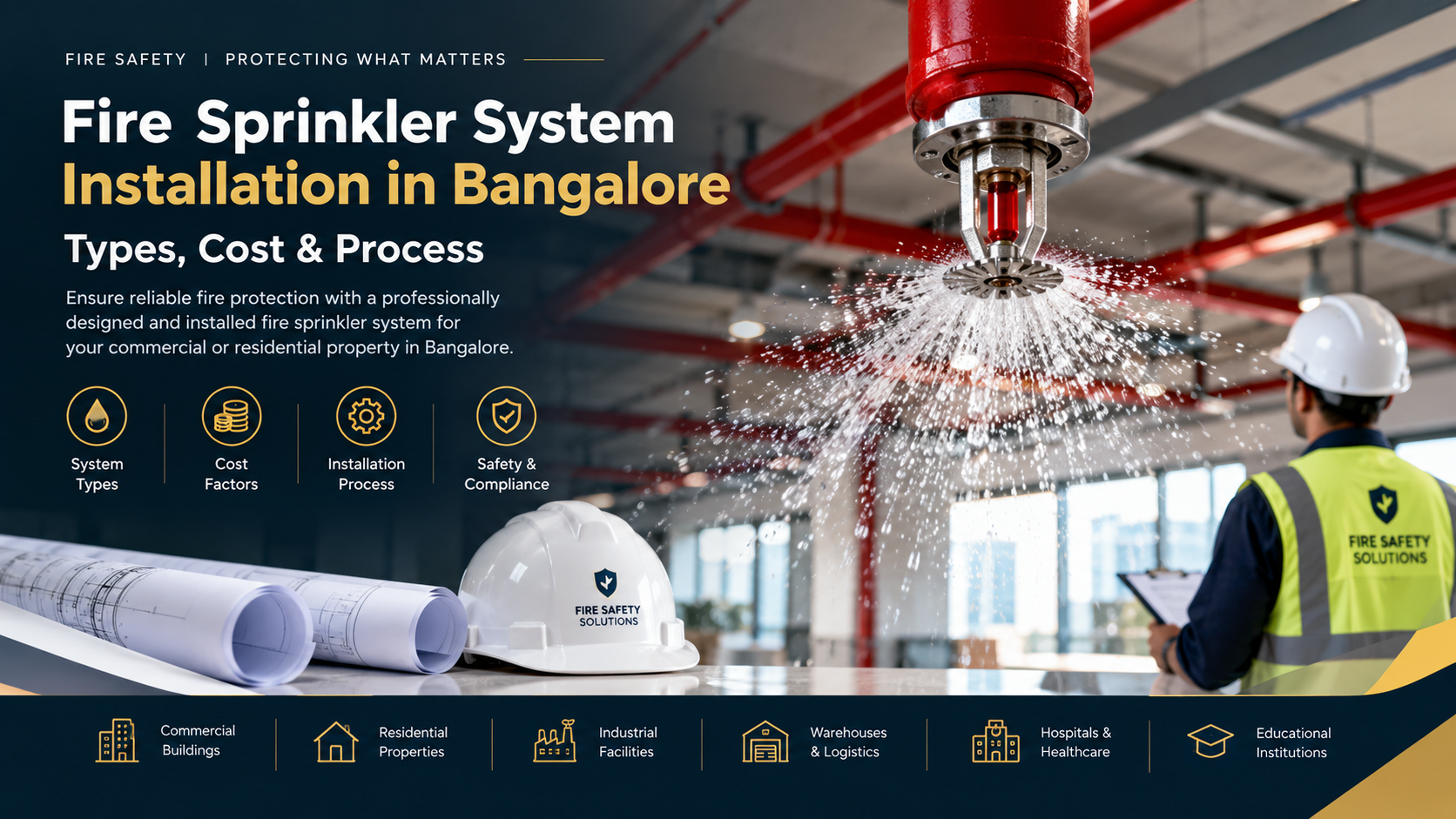
Fire Sprinkler System Installation in Bangalore: Types, Cost & Process
Fire Sprinkler System Installation in Bangalore involves more than installing sprinkler heads and connecting pipes. The system needs to be planned according to the building layout, occupancy, fire risk, water supply and applicable fire-safety requirements. The installation process can include system design, hydraulic calculations, piping, sprinkler heads, valves, fire pumps, testing and commissioning. Valuable Security Solution helps property owners, commercial enterprises, and facility managers across Bangalore plan and deploy reliable fire protection infrastructure that complies with recognized engineering codes.
What Is a Fire Sprinkler System and How Does It Work?
A fire sprinkler system is an active fire protection measure consisting of an overhead water pipe network fitted with heat-sensitive sprinkler heads at calculated intervals. The system automatically discharges water directly over the origin of a fire when elevated temperatures indicate a blaze.
Each sprinkler head features a liquid-filled glass bulb or a fusible solder link that seals the water outlet. When ambient heat rises to a predetermined threshold, commonly 68°C (indicated by a standard red liquid bulb), the liquid expands, breaking the glass bulb. This releases the internal plug, permitting pressurized water from the pipe network to strike a deflector plate and disperse in a calculated spray pattern over the burning material.
Contrary to popular movie depictions, sprinkler heads do not all discharge simultaneously unless configured as a specialized deluge system. Only the specific heads directly exposed to the fire’s heat activate, limiting fire damage while containing the fire load.
[ Elevated Heat from Fire ] ──> [ Thermal Bulb Shatters ] ──> [ Water Discharges Directly Over Fire ]
                                                                             │
[ Central Alarm Notification ] <── [ Flow Switch Detects Movement ] <────────┘
Does a Fire Sprinkler System Detect Fire Like a Fire Alarm?
A fire sprinkler system suppresses fire, whereas a fire alarm system detects and warns. A fire alarm uses smoke, heat, or flame sensors to alert building occupants to evacuate. A fire sprinkler uses mechanical heat activation to discharge water directly onto the fire to control or extinguish it before it spreads.
A sprinkler system can be designed to work alongside a fire alarm system so that water-flow information can be monitored by the alarm system where the required components and integration are provided. When a sprinkler head activates, the movement of water trips a mechanical water flow switch installed in the pipe, sending an immediate electronic signal to the main Fire Alarm Control Panel (FACP) to sound evacuation alarms and pinpoint the exact zone of the breach.
Where Are Fire Sprinkler Systems Used in Bangalore?
Bangalore’s diverse real estate landscape includes high-density commercial complexes, sprawling tech campuses, and industrial hubs. Deploying a fire sprinkler system for commercial buildings in Bangalore is dictated by occupancy classification, building height, floor area, and statutory fire-safety guidelines.
Sprinklers are deployed across various building types:
-
Corporate Offices & IT Parks: Large floor-plate facilities in hubs like Whitefield, Bellandur, and Electronic City requiring protection across workstations, server lobbies, and common egress corridors.
-
Commercial Buildings & Retail Complexes: Multi-tenant facilities and retail malls where heavy public foot traffic and open atriums demand automated suppression.
-
Warehouses & Logistics Centers: High-bay storage facilities along Hoskote or Nelamangala where vertical storage arrangements present dense fire loads.
-
Hospitals & Healthcare Facilities: Critical-care premises where phased evacuation strategies require active fire suppression to keep exit routes passable.
-
Educational Institutions & Auditoriums: Large assembly halls, student hostels, and multi-story academic blocks.
-
Residential High-Rises & Apartments: High-rise towers where municipal bylaws require internal riser systems and basement parking sprinkler coverage.
-
Industrial Plants & Manufacturing Units: Production floors in Peenya, Bommasandra, or Bidadi housing machinery, solvents, or flammable materials.
Note: Requirements for automatic fire suppression are established by Part 4 of the National Building Code of India (NBC 2016) and IS 15105. Whether a specific building requires automatic sprinklers depends on its structural classification, height, hazard class, and basement usage.
Call Us: +91-09972047466 Available for urgent security needs & installation support
Email: contact@valuablecctvsolution.com
Visit Our Office: 50/6 5th main road, 12th Cross Rd, Wilson Garden, Bengaluru, Karnataka 560027
Google Maps: Check Our Google My Business Listing for Reviews
What Types of Fire Sprinkler Systems Are Used?
Different operating environments require specific pipe architectures to balance response speed, ambient conditions, and water sensitivity.
Wet Pipe Fire Sprinkler System
The wet pipe fire sprinkler system is the most prevalent configuration across standard commercial and residential properties. The distribution pipes remain permanently charged with pressurized water. The moment a sprinkler head activates due to heat, water discharges instantly without mechanical delays. It offers straightforward maintenance and low mechanical complexity.
Dry Pipe Fire Sprinkler System
In dry pipe systems, the piping network is filled with pressurized air or nitrogen instead of water. A specialized dry pipe valve holds back the main water supply. When heat activates a sprinkler head, the air pressure drops, opening the valve and allowing water to flood into the piping and discharge. Dry systems are deployed in environments where ambient temperatures could cause standing pipe water to freeze, or in specialized cold-storage facilities.
Pre-Action Fire Sprinkler System
Pre-action systems require a two-stage activation process before water discharges. The pipes contain pressurized air, while an independent fire detection network (such as smoke or heat sensors) monitors the space. Water enters the pipe network only when the electronic detection system confirms a fire condition. Water will not discharge until heat shatters a specific sprinkler head. This double-interlock design prevents accidental water discharge in sensitive environments such as data centers, server rooms, and telecommunications archives.
Deluge Fire Sprinkler System
Unlike standard closed systems, deluge systems utilize open sprinkler heads or spray nozzles connected to an unpressurized dry piping network. A dedicated deluge valve holds back the water supply until triggered by a companion electrical detection system or manual pull station. Once open, water discharges simultaneously through every head across the entire zone. Deluge systems are reserved for high-hazard industrial environments, such as fuel storage areas, chemical processing facilities, and transformer bays.
| System Type | Basic Operation | Typical Consideration |
| Wet Pipe | Pipes permanently contain pressurized water. | Standard choice where freezing conditions do not occur. |
| Dry Pipe | Pipes contain pressurized air or nitrogen. | Used in cold storage or areas where water cannot sit in pipes. |
| Pre-Action | Requires electronic detection before pipes flood with water. | Deployed in mission-critical IT hubs, server rooms, and museums. |
| Deluge | Open nozzles discharge water across the entire zone at once. | High-hazard industrial plants, power plants, and chemical yards. |
What Components Are Required for a Fire Sprinkler System?
A reliable fire sprinkler system involves a coordinated network of hydraulic, mechanical, and electrical components operating under continuous pressure:
[ Dedicated Water Storage Tank ] ──> [ Fire Pump Set (Electric + Standby Diesel + Jockey) ]
                                                            │
[ Sprinkler Heads & Deflectors ] <── [ Pipe Network ] <── [ Installation Control Valve (ICV) ]
                                                            │
                                                  [ Water Flow Switch ] ──> [ Fire Alarm Interface ]
-
Sprinkler Heads: Precision-engineered nozzles fitted with thermal bulbs or links, available in pendent (downward), upright (upward), sidewall (horizontal), or concealed ceiling formats.
-
Fire Sprinkler Pipes: Heavy-grade mild steel (MS), galvanized iron (GI), or approved CPVC pipes routed through ceilings and utility shafts.
-
Alarm/Installation Control Valves (ICV): Check valves that isolate the water supply, prevent backflow into the municipal line, and channel water to the local hydraulic alarm.
-
Water Flow Switches: In-line paddle switches that detect physical water movement inside the pipe and transmit an electronic alert to the fire alarm panel.
-
Pressure Gauges: Precision dials located at key manifolds to monitor system water and air pressure.
-
Main Fire Pump (Electrical): High-flow industrial centrifugal pump designed to deliver design water volume and pressure across the network during an emergency.
-
Standby Diesel Fire Pump: Secondary pump that starts automatically if utility power fails during a fire event.
-
Jockey Pump: Low-volume, high-pressure auxiliary pump that maintains static system pressure and compensates for minor operational leaks without cycling the main fire pump.
-
Dedicated Static Water Storage Tank: Dedicated underground or terrace reservoir reserved exclusively for fire suppression supply.
-
Test and Drain Arrangement: Inspector’s Test Connections (ITC) and main drain assemblies used to simulate sprinkler activation and flush debris.
-
Supports and Hangers: Structural steel brackets engineered to support water-filled pipe loads and absorb hydraulic shock loads.
How Is Fire Sprinkler System Installation Done in Bangalore?
Executing Fire Sprinkler System Installation in Bangalore requires adherence to engineering standards and regional fire-safety clearances. The implementation sequence must remain methodical from initial survey through final testing.
1. Site Assessment
Engineers physically walk the facility to inspect architectural framing, ceiling clearance, structural load capacity, utility routes, and available space for pump rooms and dedicated water storage tanks.
2. Building and Fire-Risk Assessment
The facility’s occupancy classification (Light Hazard, Ordinary Hazard, or High Hazard) is evaluated in accordance with statutory guidelines to determine the required design density and water demand.
3. Fire Sprinkler System Design
Engineers draft a customized fire sprinkler system design detailing pipe layouts, head spacing, hydraulic branch lines, control valve zones, and riser positions.
4. Hydraulic Calculations
Specialists execute mathematical calculations to model friction loss, pipe diameter requirements, equivalent lengths of fittings, and minimum pressure requirements at the most remote sprinkler head.
5. Equipment and Material Selection
Piping schedules, pump capacities, and thermal ratings are selected to match project requirements, ensuring compliance with manufacturing standards (such as IS 15105 or equivalent quality benchmarks).
6. Pipe and Sprinkler Installation
Trained pipefitters install structural hangers, weld or groove pipe networks, position headers, mount installation control valves, and fit sprinkler heads at calculated elevations to prevent ceiling obstructions.
7. System Testing
The completed pipe network undergoes hydrostatic pressure testing to verify joints, fittings, and welds under high pressure without leakage.
8. Commissioning and Handover
Pumps, flow switches, and pressure alarms are verified in dynamic operation. The final documentation, including as-built drawings and operation logs, is compiled for building owners.
This comprehensive workflow addresses the requirements for how to install a fire sprinkler system in a commercial building while maintaining strict engineering standards.
What Factors Affect Fire Sprinkler System Design?
Sprinkler infrastructure is calculated around the thermodynamic realities of the protected space. Key design variables include:
-
Occupancy Type: An IT call center features different fire dynamics than a commercial printing press or packaging warehouse.
-
Fire Hazard Classification: Groupings (Light, Ordinary, or High Hazard) dictate the minimum water discharge density (liters per minute per square meter).
-
Building Height and Floor Area: Structural elevations require higher head pressure and staged vertical riser networks to deliver water to top floors.
-
Ceiling Height and Arrangement: Tall industrial ceilings require specialized Early Suppression Fast Response (ESFR) heads to penetrate rising smoke plumes.
-
Storage Configuration: High-density pallet storage, vertical racks, and aisle dimensions directly alter hydraulic demands.
-
Fire Load: The combustible material density within the space governs how long the dedicated water reserve must sustain continuous discharge (typically 30 to 90 minutes).
-
Piping Route Obstructions: Structural beams, electrical cable trays, and large HVAC ducting require careful pipe offsets to preserve uniform water discharge cones.
What Standards Apply to Fire Sprinkler Installation in India?
Fire suppression systems must be designed, installed, and maintained in accordance with national safety codes and local municipal directives:
[ NBC 2016 Part 4 ] ──> Mandates where automatic suppression is required by occupancy & height.
         │
[ IS 15105 Code of Practice ] ──> Dictates pipe sizing, head spacing, hydraulic math, & pump sizing.
         │
[ Local Fire Authority (KFES) ] ──> Conducts site inspections and issues Fire Clearance Certificates (NOC).
-
NBC 2016 Part 4 (Fire and Life Safety): Defines occupancy groupings, structural requirements, egress widths, and mandatory thresholds for installing automatic sprinkler networks based on building height and floor area.
-
IS 15105: The Bureau of Indian Standards (BIS) code of practice governing the design, hydraulic layout, pipe material, spacing, installation, and testing of fixed automatic sprinkler fire extinguishing systems.
-
Local Fire Authority Guidelines: Directives issued by the Karnataka Fire and Emergency Services (KFES) governing plan clearances, on-site commissioning inspections, and Fire Safety Recommendation (NOC) compliance.
How Much Does Fire Sprinkler System Installation Cost in Bangalore?
There is no universal, flat-rate pricing for installing a fire sprinkler network. The final Fire Sprinkler System Cost in Bangalore depends on building architecture, occupancy risk, hydraulic design requirements, and equipment specifications.
Factors That Affect Fire Sprinkler System Installation Cost in Bangalore
-
Building Scale & Area: Large open-plan properties leverage economy of scale across pipe runs, while highly partitioned spaces require more branch lines and fittings.
-
Hazard Classification: High-hazard industrial facilities demand larger pipe diameters, higher-rated pumps, and specialized sprinkler heads.
-
Piping Material & Joining Methods: Threaded, grooved, or welded steel networks carry different material and skilled labor costs.
-
Pump Room Infrastructure: Installing a complete three-pump set (electric main, diesel standby, jockey) with control panels represents a major portion of project capital.
-
Water Storage Capacity: Providing a dedicated civil or modular water storage tank adds to the overall civil and plumbing budget.
-
Ceiling Complexities: Finished decorative ceilings requiring concealed heads and flexible stainless-steel drops cost more than exposed industrial ceilings.
-
Retrofit vs. New Construction: Installing pipework into an occupied, existing commercial space requires phased night labor and structural coordination, altering labor costs.
Because system pricing relies on accurate hydraulic engineering, obtaining an itemized, property-specific proposal is the most reliable way to forecast your project budget.
What Should a Fire Sprinkler Installation Quotation Include?
When reviewing commercial proposals for Fire Sprinkler Installation Services in Bangalore, verify that all hardware, fabrication, and commissioning steps are transparently accounted for:
| Quotation Item | What to Verify in the Proposal |
| System Classification | Explicit statement of system type (Wet Pipe, Dry, Pre-Action, or Deluge). |
| Sprinkler Heads | Make, thermal ratings, response type (standard/quick response), and quantities. |
| Piping & Structural Fittings | Pipe class (e.g., Heavy Grade MS/GI), diameters, and hanger specifications. |
| Control & Alarm Valves | Brand, size, and inclusion of water motor alarms, flow switches, and trim piping. |
| Pumping Machinery | Head, flow rate, brand, and motor/engine ratings for electric, diesel, and jockey pumps. |
| Dedicated Water Storage | Clarification of whether water tank fabrication is included or handled by civil works. |
| Engineering Deliverables | Inclusion of detailed layout blueprints, hydraulic calculation sheets, and as-built drawings. |
| Labor & Civil Work | Fabrication, welding, grooving, core cutting, scaffolding, and structural mounting. |
| Testing Scope | Dedicated line items for hydrostatic pressure testing and flushing. |
| Commissioning & Handover | Pump testing, flow switch verification, and functional acceptance trials. |
| Documentation & Warranty | Operations manuals, manufacturer warranties, and post-installation service coverage. |
Fire Sprinkler Testing and Commissioning
Rigorous fire sprinkler testing and commissioning ensures the system performs reliably when exposed to elevated temperatures:
[ Hydrostatic Pressure Test ] ──> [ Pipe Flushing ] ──> [ Flow & Alarm Trials ] ──> [ Handover Certification ]
 (2+ hrs at elevated pressure)     (Removes debris)      (Pumps & flow switches)     (As-builts & manuals)
-
Hydrostatic Pressure Testing: The completed pipework is charged with water to an elevated test pressure (typically 1.5 times the working pressure or a minimum designated code threshold) for at least two hours to confirm the structural integrity of every weld, joint, and fitting.
-
Pipe Flushing: Main lines are flushed with high-velocity water prior to fitting the final sprinkler heads to purge scale, metal shavings, and debris that could clog nozzles.
-
Alarm & Flow Verification: The inspector’s test valve is opened to confirm that water movement trips the flow switch within the required delay window, activating the alarm gong and notifying the fire alarm panel.
-
Pump Cut-In Testing: Pressure is bled from the system manifold to confirm that the jockey pump starts automatically, followed by the primary electric pump and the standby diesel engine upon simulated pressure drops.
-
Final Commissioning Documentation: Complete test logs, pressure recording charts, and operating instructions are compiled for building records and statutory inspections.
Can a Fire Sprinkler System Be Installed in an Existing Building?
Yes, fire sprinkler systems can be retrofitted into existing, occupied buildings, though the process requires careful structural planning.
Key retrofit considerations include:
-
False Ceiling Clearances: Verifying sufficient vertical drop space between the structural slab and decorative ceiling tiles to route branch lines.
-
Structural Load Capacity: Ensuring existing beams and slabs can safely bear the dead weight of water-charged distribution pipes.
-
Dedicated Pump & Tank Space: Allocating basement or ground-level footprint for water storage reservoirs and pumping machinery.
-
Occupied Coordination: Staging pipe fabrication and core cutting outside regular business hours to prevent operational disruption.
-
Integration with Existing Systems: Connecting new riser flow switches to older fire alarm panels and coordinating pipe runs with existing HVAC ducting and electrical cable trays.
Can Fire Sprinklers Work With a Fire Alarm System?
Yes. Modern commercial fire protection relies on integrating suppression networks with electronic fire detection.
When a sprinkler head activates, water moves through the branch line. An electro-mechanical water flow switch detects this continuous movement and sends an electronic signal to a monitoring module wired into the building’s Fire Alarm Control Panel (FACP).
The fire alarm system then:
-
Identifies the exact floor and riser zone where suppression is occurring.
-
Activates audible sounders, voice evacuation speakers, and strobes across the building.
-
Triggers automated HVAC shut-offs to prevent smoke recirculation.
-
Releases fail-safe access control doors along designated fire exit stairwells.
If your facility requires a complete early-warning setup alongside suppression, our dedicated Fire Alarm System Service in Bangalore provides end-to-end design, addressable panel configuration, and multi-sensor integration.
What Is the Difference Between Fire Sprinkler Installation and Fire Alarm Installation?
While both systems protect life and property, their core mechanisms and operational roles differ:
| Functional Parameter | Fire Sprinkler System | Fire Alarm System |
| Primary Objective | Controls or suppresses active fires through water discharge. | Detects combustion products and provides early evacuation alerts. |
| Trigger Mechanism | Heat-sensitive mechanical bulb or fusible solder link. | Optical smoke, heat, flame, or gas sensors. |
| Primary Infrastructure | Heavy-gauge piping, pumps, valves, and water storage. | Armored/shielded electrical cabling, control panels, and modules. |
| Engineering Focus | Hydraulic math, pipe friction, flow rate, and water head. | Circuit loop integrity, sounder decibels, and addressable zones. |
| System Output | Direct physical water discharge onto burning assets. | Audible sirens, strobe lights, and digital emergency signals. |
| Integration Role | Sends water-flow status signals to the alarm panel. | Monitors sprinkler valves and coordinates building evacuation. |
How to Choose a Fire Sprinkler System Installation Company in Bangalore
Selecting a qualified fire safety engineering contractor requires verifying technical capabilities beyond simple commercial bids.
-
Mandatory Site Evaluation: Ensure the contractor conducts a physical site survey before submitting an equipment proposal.
-
Knowledge of Standards: Verify that the team designs systems in strict compliance with IS 15105 and NBC 2016 Part 4.
-
Hydraulic Design Capabilities: Confirm that the engineering team calculates pipe friction losses and water demands mathematically rather than using guesswork.
-
Transparent Component Breakdown: The proposal must itemize pipe grades, pump ratings, valve models, and sprinkler types.
-
Testing and Commissioning Scope: Ensure the quote includes complete hydrostatic testing, flushing, and pump performance runs.
-
Post-Handover Support: Check that the contractor provides ongoing maintenance, Annual Maintenance Contracts (AMC), and emergency repair capabilities.
Valuable Security Solution provides security and fire-safety solutions in Bangalore, allowing businesses and property owners to discuss their site requirements, system scope, and installation needs with a local security solutions provider.
Fire Sprinkler System Installation in Bangalore by Valuable Security Solution
Valuable Security Solution supports fire protection requirements for properties in Bangalore by helping customers assess their site, understand the required sprinkler system components, and plan installation according to the property’s layout and fire-safety requirements.
Depending on the project, the scope can involve sprinkler system planning, equipment selection, piping, sprinkler heads, valves, fire pumps, testing, commissioning, and ongoing support. The actual system configuration is determined after reviewing the property’s occupancy, layout, fire risk, water supply, and applicable requirements.
[ Site Assessment ] ──> [ System Planning ] ──> [ Itemized Quotation ] ──> [ Certified Installation ]
                                                                                   │
[ Ongoing Support ] <── [ Formal Commissioning ] <── [ Hydrostatic Testing ] <─────┘
-
Site Assessment: Comprehensive on-site survey to map floor layouts, ceiling voids, and pump room space.
-
System Planning: Developing compliant pipe routing, sprinkler positioning, and hydraulic specifications.
-
Quotation: Providing transparent, line-item budgets covering equipment, labor, and testing.
-
Installation: Professional fabrication, pipe hanging, and valve manifold assembly.
-
Testing: Systematic hydrostatic pressure verification and flow trials.
-
Commissioning: Validating pump automation, flow switch relays, and alarm synchronization.
-
Support: Delivering as-built layouts, maintenance schedules, and ongoing service support.
What Types of Properties Can Valuable Security Solution Support?
Every facility presents unique structural challenges and risk profiles. We support fire protection planning for:
-
Commercial Buildings: Multi-tenant office developments, corporate parks, and co-working facilities.
-
Offices & Retail Outlets: High-traffic retail storefronts, showrooms, and branch offices.
-
Warehouses & Logistics Hubs: High-bay distribution yards, cold storages, and inventory facilities.
-
Apartments & High-Rise Residences: Residential towers requiring basement, lobby, and riser installations.
-
Educational Institutions: Universities, schools, auditoriums, and campus research labs.
-
Industrial Properties: Manufacturing floors, chemical assembly sheds, and engineering plants.
Fire Sprinkler Installation Services in Bangalore
If you are planning Fire Sprinkler System Installation in Bangalore, the first step is to understand the property’s layout, occupancy, fire risk, and existing fire-safety infrastructure. Valuable Security Solution can help you discuss the required system scope and installation requirements before proceeding with a formal quotation.
-
Request an On-Site Property Assessment
-
Obtain an Itemized Fire Sprinkler System Proposal
FAQs About Fire Sprinkler System Installation in Bangalore
What is a fire sprinkler system?
A fire sprinkler system is an active fire protection installation consisting of a water supply network and overhead piping fitted with heat-sensitive sprinkler heads designed to automatically discharge water over a fire to control or extinguish it.
How does an automatic fire sprinkler system work?
When heat from a fire reaches a specific temperature (commonly 68°C), a liquid-filled glass bulb inside the nearest sprinkler head shatters. This unplugs the nozzle, allowing pressurized water to discharge directly onto the flames.
How much does fire sprinkler system installation cost in Bangalore?
Costs vary based on building square footage, hazard classification, pump room machinery, pipe materials, and ceiling complexity. An on-site survey and hydraulic calculation provide the most accurate, property-specific estimate.
Which fire sprinkler system is suitable for a commercial building?
Most standard commercial buildings utilize wet pipe systems because they are reliable, cost-effective, and provide immediate discharge. Sensitive areas like server rooms may use pre-action systems to avoid accidental water discharge.
What is a wet pipe fire sprinkler system?
A wet pipe fire sprinkler system is an installation where the overhead piping network is constantly filled with pressurized water, ensuring immediate discharge the moment a thermal sprinkler bulb activates.
How to install a fire sprinkler system in a commercial building?
Installation involves evaluating fire risks, executing hydraulic calculations, routing heavy-gauge piping, installing control valves and fire pumps, mounting sprinkler heads, and completing hydrostatic testing and commissioning.
Can sprinklers be installed in an existing building?
Yes. Retrofitting requires evaluating structural ceiling clearances, identifying pipe routes, allocating space for pumps and water storage, and staging fabrication to avoid interrupting building operations.
Can a sprinkler system work with a fire alarm?
Yes. Water flow switches installed along the sprinkler piping detect water movement when a head activates, sending an immediate signal to the Fire Alarm Control Panel to sound building-wide evacuation alarms.
What should a fire sprinkler installation quotation include?
A transparent proposal should itemize sprinkler head types and quantities, pipe specifications, control valves, pump ratings, water storage provisions, labor, hydrostatic testing, and commissioning documentation.
Is testing required after sprinkler installation?
Yes. Standards like IS 15105 mandate hydrostatic pressure testing (maintaining elevated water pressure for at least two hours), pipe flushing, and dynamic pump cut-in trials prior to final handover.
Need Fire Sprinkler System Installation in Bangalore?
Planning a sprinkler system for a commercial, residential, industrial, or institutional property? Valuable Security Solution can help you evaluate your site requirements, system scope, installation guidelines, and testing procedures.

Siddu Swami Hiremath is the Founder & CEO of Valuable Security Solution, a Bengaluru-based company specializing in CCTV camera installation, electronic security systems, and surveillance solutions. With over 15 years of hands-on experience in the security industry, he has helped homeowners, businesses, apartments, offices, schools, and industrial facilities implement reliable CCTV systems, access control systems, biometric attendance solutions, fire alarm systems, and burglar alarm systems. His expertise in designing customized security solutions has made Valuable Security Solution a trusted name for CCTV installation in Bangalore. Known for same-day site surveys, professional installation, best-price guarantee, and 24/7 technical support, Siddu is committed to delivering advanced security solutions that ensure long-term safety, protection, and peace of mind.